
The question arrives in almost every first conversation, and it is usually put as though it has a yes or a no behind it. It does not. A foreigner cannot own land in Thailand. A foreigner can own a condominium unit outright, can own a building standing on somebody else's land, and can buy thirty registered years of a villa. Which of those is open to you depends far less on your budget than on what is standing on the plot.
What follows is the map: the four routes, what each one actually gives you, what the statute requires, and the one structure that is offered constantly in Phuket and is a criminal offence for everybody who signs it.
Two things before the detail. Everything below rests on unofficial English translations of Thai statutes — only the Thai text has legal force, and the sources block names every translation we relied on. And none of it is legal advice. It is what the desk sees, written so that you can ask a Thai lawyer sharper questions than we can answer.
The rule everything else is built around
Aliens may acquire land by virtue of the provisions of a treaty giving the right to own immovable properties and subject to the provisions of this Code.
Land Code B.E. 2497, Section 86
Read it twice. It is not a prohibition; it is a permission that has nothing to attach to. Thailand has no treaty in force granting foreign nationals the right to own land, so the gateway in Section 86 opens onto nothing. Section 87 goes on to set the areas an alien could hold under such a treaty — one rai for a residence, ten for agriculture — and those ceilings have sat unused for seventy years.
The other half of the rule is about companies. Sections 97 and 98 treat a juristic person as an alien for land purposes when more than 49% of its registered capital is held by foreigners, or when more than half of its shareholders are foreigners. That single sentence is the origin of every 51-49 Thai company you will be shown in Phuket, and of the enforcement that now follows them around.
What is actually for sale
The legal question only bites where the stock is. On 8 September 2026 our catalogue held 679 priced, available sale listings across Phuket. Villas are 551 of them.
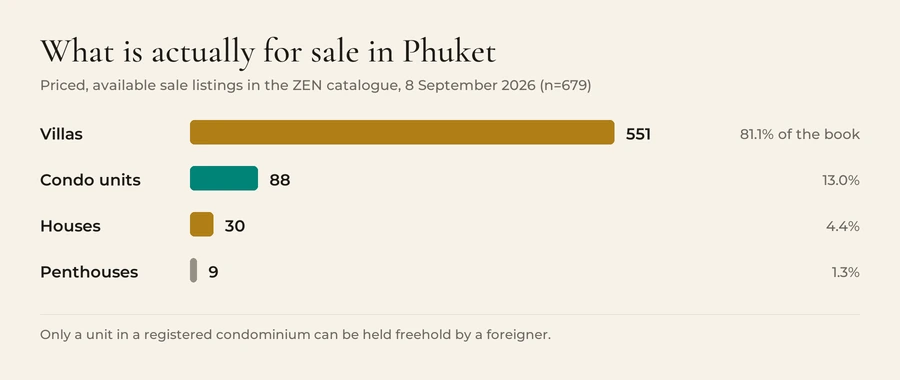
| Type | Listings | Share | Freehold in a foreigner's own name? |
|---|---|---|---|
| Villas | 551 | 81.1% | No — the land is the obstacle |
| Condominium units | 88 | 13.0% | Yes, inside the building's 49% quota |
| Houses | 30 | 4.4% | No — the land is the obstacle |
| Penthouses | 9 | 1.3% | Only if the building is condominium-registered |
So roughly six listings in seven sit on land, and the freehold route is not available on any of them. Note the caveat in the last row, because it applies more widely than it looks: our catalogue records what a property is marketed as, not what title it carries. Whether a particular building is registered under the Condominium Act, and whether its foreign side still has room, is a question for the juristic person's own register — not for a listing page, ours included.
There is a second thing the split hides. Choosing freehold is not a paperwork preference, it is a change of asset.
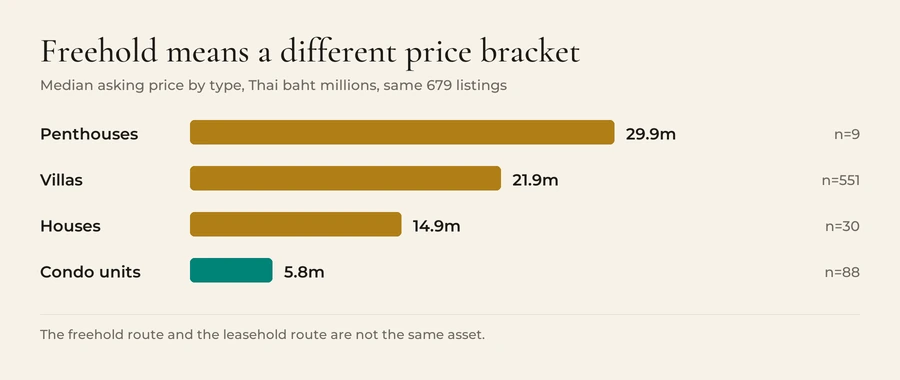
The median condominium unit on our book asks ฿5,800,000. The median villa asks ฿21,900,000. A buyer who insists on freehold has not chosen a safer version of the villa — they have chosen a different building, in a different place, at roughly a quarter of the price.
Route one — a condominium unit, in your own name
This is the only route on which a foreign individual takes the same title a Thai buyer takes. Section 19 of the Condominium Act B.E. 2522 lists five categories of alien who may hold a unit: holders of a residence permit, those admitted under the investment promotion law, juristic persons that count as Thai under Land Code Sections 97 and 98, foreign juristic persons holding a BOI promotion certificate, and — the one nearly every private buyer uses — an alien who has brought foreign currency into the Kingdom, or drawn on a non-resident baht account or a foreign currency account, to pay for the unit.
That last route is a documentary condition, not a formality. The money must arrive from abroad in foreign currency and be converted here, and the receiving bank's evidence of it is what the Land Office wants to see on the day of transfer. Money already sitting in your Thai baht account will not do the job by itself.
Then the ceiling, in Section 19 bis: aliens may collectively hold not more than 49% of the total floor area of all units in a given condominium. Floor area, not unit count — a detail that decides real cases, because a building whose foreign quota is exhausted by a handful of large units still has small ones it cannot sell to you freehold. What is offered instead, routinely, is a lease of the same unit. That is route two wearing route one's clothes, and it should be priced accordingly.
Ask for the juristic person's foreign-quota position in writing, addressed to your unit, before you pay anything — and take the conveyancing opinion from your own lawyer, because ZEN does not handle condominium sales.
Route two — a registered lease
This is how most foreign money reaches a Phuket villa. A lease of immovable property longer than three years is enforceable only for three years unless it is registered at the Land Office (Civil and Commercial Code, Section 538), and Section 540 caps the term at thirty years. Registered, it is endorsed on the title and it survives a sale of the land.
The trap is not the thirty years. It is the "+30+30" written after them. We have covered that in full in the 30-year leasehold, honestly, including the 2025 Supreme Court decision that put a Phuket lessee out at the end of year 30 after paying for ninety. The short version, which has not changed: a renewal clause is a personal promise against the person who made it, not a right in the land. Price the villa at thirty years and treat anything beyond as a bonus you have not paid for.
Route three — the forty-million-baht permission
There is a genuine, lawful way for a foreign individual to hold Phuket land in their own name, and almost nobody uses it. Section 96 bis, inserted into the Land Code by the Land Code Amendment Act (No. 8) B.E. 2542, allows an alien who brings in at least ฿40,000,000 for investment in assets prescribed by Ministerial Regulation to acquire land for residence, on these conditions:
- Not more than one rai — 1,600 square metres.
- Residential use only, and the land must be put to that use within two years of registration or the Director-General may order it disposed of.
- Permission granted by the Minister of Interior, case by case.
- The investment must be maintained for not less than three years.
- The land must lie in Bangkok, Pattaya, a municipality, or an area zoned for residence under the town planning law.
Two honest caveats. First, on the holding period: the two independent translations of the amendment act we read both say three years, while several widely-circulated guides say five. We have not seen the Thai text of the current Ministerial Regulation, so treat the number as three with a question mark against it, and have a Thai lawyer confirm it before you rely on it. Second, we could find no published count of how many permissions have ever been granted — the Land Department does not appear to publish one, and we are not going to invent a figure. What we can say is that in Phuket we have not transacted one, and the practitioners who write about it describe it as rare.
The other thing to understand is what the ฿40,000,000 is. It is not the price of the house. It is money brought in and parked in prescribed investments — government and Bank of Thailand bonds, certain funds, BOI-promoted activity — on top of whatever the land costs. The route exists; it is simply expensive in a way that has nothing to do with the property.
Route four — a Thai company, and why we do not arrange one
The pitch is familiar enough to recite. A Thai limited company is formed, 51% held by Thai shareholders you will never meet, 49% by you, with preference shares and a shareholders' agreement arranging that your minority votes control it. The company buys the villa. You are told this is how everyone does it.
Two statutes meet here, and both point the same way. Land Code Sections 97 and 98 already deem a company alien on foreign shareholding above 49% or foreign shareholders above half — so a structure engineered to leave a foreigner in control of a Thai-majority company is not a clever reading of the rule, it is the thing the rule exists to catch. And Section 36 of the Foreign Business Act B.E. 2542 makes it an offence for a Thai national to hold shares as a foreigner's nominee, or to assist a foreigner in operating a business the foreigner may not operate. The penalty reported for it is imprisonment of up to three years, a fine of ฿100,000 to ฿1,000,000, or both — falling on the Thai shareholders as well as the foreigner, with the court empowered to order the shareholding unwound.
This is not a dormant provision. Enforcement stepped up through 2025 and 2026, with the Department of Business Development tightening registration scrutiny and working alongside the DSI and AMLO on nominee cases. A law-firm briefing we relied on dates a DBD order tightening company registration to 1 January 2026; we have not read the order itself and cite it as the briefing's account rather than our own.
The test we apply is simple, and it is worth applying to yourself. Does the company have a business, capital its Thai shareholders actually contributed, and a reason to exist beyond holding your house? If the honest answer is no, what has been sold to you is not a structure. It is a shared criminal exposure with a filing fee attached.
None of which makes every Thai company unlawful. A genuinely trading company with real Thai capital can hold land it uses. That is a different animal from the one being offered on the beach road.
Rights that sit alongside a lease, not instead of one
Three lesser-known rights come up in villa transactions, usually stacked on top of a lease rather than replacing it. All are registrable against the title.
| Right | What it gives | How long | Sections |
|---|---|---|---|
| Usufruct | Possession, use and enjoyment of the land, and the right to manage it | A fixed term, or the holder's lifetime. It ends on the holder's death in every case, so it cannot be inherited | ss.1417–1428 |
| Superficies | The right to own a building on land belonging to someone else — the structure is titled separately from the ground | Fixed term or lifetime | ss.1410–1416 |
| Habitation | The right to live in a dwelling rent-free. Personal, and cannot be transferred | Fixed term or lifetime | ss.1402–1409 |
Usufruct is the one worth understanding, because it can outlast a lease: granted for life, it runs as long as you do. What it will not do is pass to your children — the Code ends it at the usufructuary's death — and it is not a substitute for a term you can sell on. Superficies is the quiet workhorse of the villa market, and the reason a foreigner can own the house while a Thai party owns the ground beneath it.
If you are married to a Thai national
Your Thai spouse may buy land in their sole name. Since a Ministry of Interior instruction of 23 March 1999, the Land Office handles it by having both spouses sign a joint declaration that the funds are the Thai spouse's personal property — sin suan tua — and not marital property, which follows from Section 1472 of the Civil and Commercial Code.
Be clear about what you have signed. The declaration says the money was never yours. It is the price of the transaction proceeding, and it is the reason a foreign spouse who later separates finds the land is not divisible marital property. Couples who want the foreign spouse protected usually register a usufruct or a long lease in their favour over the same land at the same time. Do it on the day, not later.
Five ways this goes wrong
- Paying before the quota is confirmed. The foreign side of a condominium fills up. Get the juristic person's written confirmation for your specific unit before any deposit leaves your account.
- Sending the money the easy way. Funds transferred as baht, or moved from an existing Thai account, can fail the Section 19 currency condition. Brief your bank on the purpose before the transfer, not after.
- Buying a renewal. Paying ninety years' value for a thirty-year registered lease plus two promises. Price the thirty.
- Taking the company because it is quicker. It exposes your Thai shareholders to prosecution as well as you, and it is the structure enforcement is actively looking for.
- Leaving the foreign spouse with nothing registered. A declaration that the money was not yours, and no usufruct or lease to show for it, is the worst position in this article.
Before you sign anything
- A title search at the Land Office, in Thai, with the deed type identified.
- For a unit: written confirmation of the building's foreign quota position, dated, for your unit.
- For a lease: the registration appointment booked, and the 1.1% of total rent budgeted for fees and duty.
- For any company proposal: the Thai shareholders' identities, their contributed capital, and the company's actual business — in writing.
- Your own Thai lawyer, instructed by you and paid by you, not one introduced by the seller.
The routes are narrower than the marketing suggests and wider than the pessimists claim. What decides the outcome is matching the route to the asset before you fall in love with a house that cannot be held the way you want to hold it. If you would rather start from what you are trying to achieve, our sale quiz takes a few minutes and puts a real person on the other end of it — or look at what is currently for sale in Phuket with the title question already in mind.