
A long-term villa lease in Phuket is usually shorter than people expect. Two or three pages, in English, on the landlord's own template, and the tenant signs it in an afternoon.
It is short because most of it has already been written. Sections 537 to 571 of the Civil and Commercial Code govern the hire of property in Thailand, and they apply to your villa whether or not the contract mentions them. The clauses that matter are therefore of two kinds: the ones that quietly displace a default in your favour or against it, and the ones filling a gap the Code leaves open. The deposit is the largest of those gaps.
Below: what the law gives you before anyone negotiates, what a long lease costs to make stick, and the six things we argue about on behalf of tenants.
The three-year line
Everything about the paperwork changes at three years.
A hire of immovable property is not enforceable by action unless there be some written evidence signed by the party liable. If the hire is for more than three years or for the life of the letter or tenant, it is enforceable only for three years unless it is made in writing and registered by the competent official.
Civil and Commercial Code, Section 538
At three years or less, a signed written lease is enough. Nobody goes to the Land Office and nothing is endorsed on the title. At three years and one day, an unregistered lease does not fail — it shrinks. You keep three years and lose the rest, and you find that out at the point you most need the remainder.
Registration is not free. The Land Department charges a registration fee of 1% of the rent for the whole term, and stamp duty runs at 1 baht per 1,000 baht of rent and key money over the term, or 0.1%. Together, 1.1% of everything you will ever pay under the lease, due on the day it is registered.
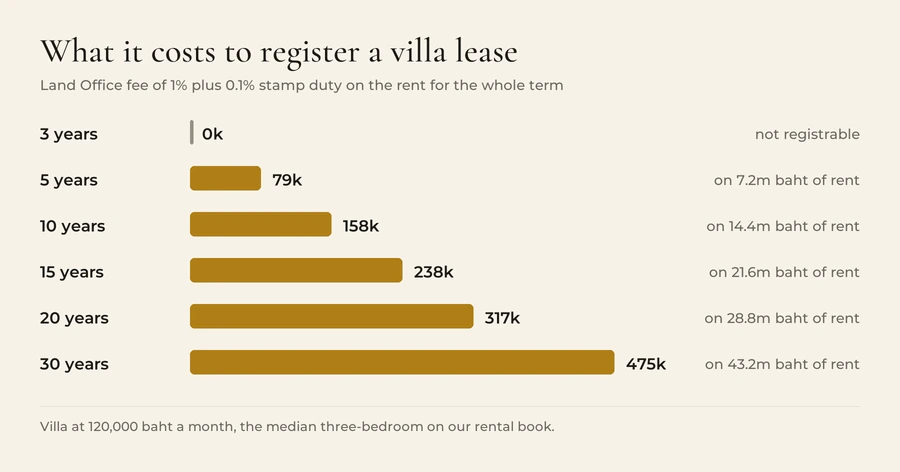
| Term | Total rent | Registration 1% | Stamp duty 0.1% | Total |
|---|---|---|---|---|
| 3 years | ฿4,320,000 | — | ฿4,320 | ฿4,320 |
| 5 years | ฿7,200,000 | ฿72,000 | ฿7,200 | ฿79,200 |
| 10 years | ฿14,400,000 | ฿144,000 | ฿14,400 | ฿158,400 |
| 15 years | ฿21,600,000 | ฿216,000 | ฿21,600 | ฿237,600 |
| 20 years | ฿28,800,000 | ฿288,000 | ฿28,800 | ฿316,800 |
| 30 years | ฿43,200,000 | ฿432,000 | ฿43,200 | ฿475,200 |
Calculated on a villa at ฿120,000 a month — the median asking rent across 828 priced, available three-bedroom villas and houses on our book on 1 September 2026. Stamp duty is payable on a lease of any length; only the 1% registration fee waits for the three-year line.
Two details in the Revenue Department's own schedule are worth knowing before you agree who pays. First, the duty is charged to the person providing the rental — the landlord — and it is the tenant who is liable to cancel the stamps. Market practice in Phuket puts the whole 1.1% on the tenant. That is a negotiated position, not a legal one, and it is negotiable. Second, if the contract states no period at all, the schedule deems it a three-year lease for duty purposes; and where a lease ends, the tenant stays on unopposed and no new contract is signed, the old one is deemed renewed and duty falls due within thirty days.
What the Code gives you without asking
These are the positions your lease starts from. A clause that contradicts one of them is not necessarily void — most of these are default rules the parties may vary — but it should be read as a deliberate transfer of risk rather than boilerplate.
| Question | The default | Section |
|---|---|---|
| Who fixes the aircon? | The landlord makes all repairs that become necessary during the term. The tenant does ordinary maintenance and petty repairs, and must take the care a person of ordinary prudence would take of their own property | ss.550, 553 |
| Can the landlord walk in? | The tenant must allow inspection at reasonable times — not at any time | s.555 |
| Can I repaint or rebuild? | No alterations or additions without the landlord's permission | s.558 |
| Can I sublet or let a friend take over? | No, unless the contract says otherwise | s.544 |
| I am late with the rent. What happens? | On rent payable monthly or at longer intervals, the landlord must first give notice of not less than fifteen days before terminating | s.560 |
| Do I have to give notice at the end of the term? | No. A fixed-term lease ends when it ends, without notice from either side | s.564 |
| What if there is no fixed term? | Either side may end it at the close of a rent period, on notice of at least one rent period — but never more than two months | s.566 |
| The owner sells the villa. Am I out? | No. A transfer of ownership does not extinguish the lease; the buyer inherits it | s.569 |
| I stayed on past the end date and nobody objected. | The lease is treated as renewed for an indefinite period, terminable under s.566 | s.570 |
| How long can the landlord chase me after I move out? | Six months from the return of the property | s.563 |
Section 569 is the one tenants underrate. Villas change hands mid-lease here and the buyer steps into the seller's shoes. It is also why a promise that sits outside the lease — a verbal arrangement about the pool service, an understanding about the fifth bedroom — travels no further than the person who made it. The same distinction does the damage on the sale side, in the 30-year leasehold, honestly.
The deposit, which the Code does not govern
Search the hire-of-property sections for the word deposit and you will not find it. Security deposits in Thailand are pure contract: whatever the lease says, subject to general principles of fairness. That is why deposit disputes are the single most common thing tenants come back to us about.
There is a consumer-protection regime that fills the gap, and it is worth knowing whether it reaches you. The Contract Committee's notification making residential building leasing a contract-controlled business, issued on 30 May 2025, requires operators to use a standard contract published by the Office of the Consumer Protection Board. The OCPB's own model short-term lease sets out, among other things:
- The operator must send the bill — rent, utilities and service charges — at least three days before the payment date, and the tenant may check what is being charged.
- A record of the condition of the building and its contents must be attached to the lease, with a copy given to the tenant.
- At the end of the lease the deposit is returned immediately, unless the operator wishes to inspect for damage. Where there is none, it comes back within seven days of the lease ending and possession being regained. Where there is damage, the balance follows within fourteen days — and nothing may be deducted for normal use, normal deterioration, or anything that is not the tenant's fault.
- On a fixed-term lease the tenant may leave early, provided they have lived there for at least half the term, give thirty days' written notice and are not in arrears. Prepaid rent comes back within seven days.
- The operator terminating for breach must give written notice and at least thirty days to put it right — seven days where the conduct directly affects other residents.
Now the caveat, which matters more than the list. The regime binds businesses that let residential units at or above a stated minimum number of units. The 2018 notification it replaces set that threshold at five. Thai commentary on the 2025 notification consistently reports it as three, but we were not able to obtain the Royal Gazette text to confirm it, and one summary still quotes five. Treat the threshold as unsettled. A private owner letting one villa is outside the regime on any reading of it, and most Phuket villa landlords are exactly that.
The practical version: if the regime does not reach your landlord, ask for its terms as terms. A seven-day deposit return, a signed condition report with photographs, and a bar on deducting for fair wear and tear are all drawn from the state's own model contract, and all far easier to agree the week before you sign than the week after you leave.
What lands on the table at signing
The shape we quote most often on a villa let is two months' deposit and the first month's rent up front. Your landlord may want more or less. The order of magnitude is the point:
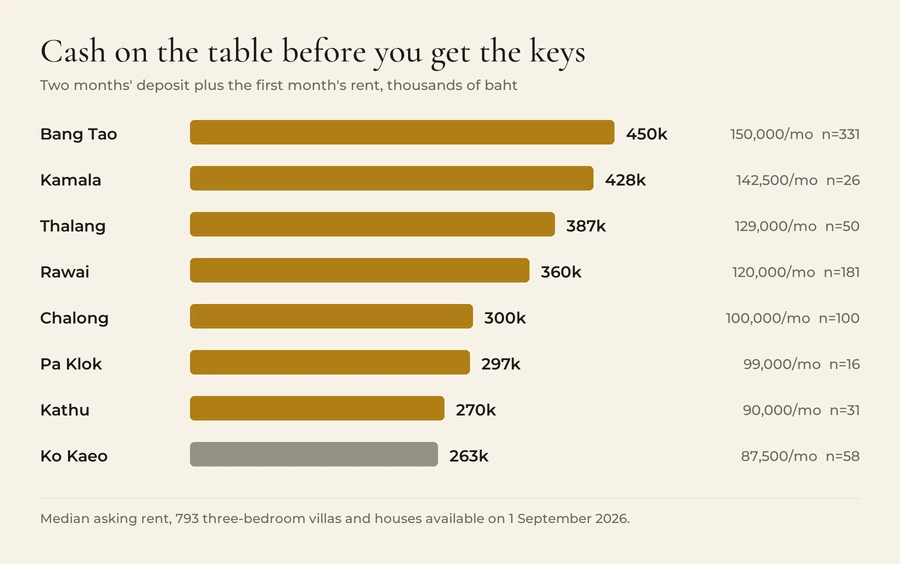
| District | Median asking rent | Deposit + first month | Sample |
|---|---|---|---|
| Bang Tao | ฿150,000 | ฿450,000 | 331 |
| Kamala | ฿142,500 | ฿427,500 | 26 |
| Thalang | ฿129,000 | ฿387,000 | 50 |
| Rawai | ฿120,000 | ฿360,000 | 181 |
| Chalong | ฿100,000 | ฿300,000 | 100 |
| Pa Klok | ฿99,000 | ฿297,000 | 16 |
| Kathu | ฿90,000 | ฿270,000 | 31 |
| Ko Kaeo | ฿87,500 | ฿262,500 | 58 |
Median asking rents across 793 priced, available three-bedroom villas and houses in these eight districts on 1 September 2026, out of 828 island-wide. Asking rents, not signed rents — long lets are negotiated, and low season moves them.
Six clauses to get right
- Term, and whether it is registered. If the lease runs past three years, either it goes to the Land Office or you are holding three years and a conversation. Agree who pays the 1.1% in the lease itself, in figures.
- The deposit mechanism, not just the number. How many months, what may be deducted, who inspects, how many days until it comes back, and to which account. A deposit clause that says only the amount is half a clause.
- The condition report. Photographed, dated, signed by both sides, annexed to the lease. This is the single cheapest thing you can do at signing and the one that decides the deposit argument.
- The repair threshold in baht. The Code splits repairs between necessary works (landlord) and petty maintenance (tenant), which is a boundary rather than a line. Put a number on it — anything under so much, the tenant handles; above it, the landlord — and name who holds the pool and garden contracts.
- Utilities at cost. Electricity and water billed at the provider's own rate against the meter, with the bills shown. Where a villa sits behind an estate meter, ask what the estate adds and get the multiplier written down.
- Early exit, sublet and sale. A break clause with a stated notice period, because the Code gives you none on a fixed term. Express permission to sublet or assign if you might need it, because section 544 says no by default. And confirmation that the landlord will tell a buyer about your lease — section 569 protects you, but a buyer who learns of you at handover is a bad start to the remaining term.
Before you sign
- Title deed or the owner's own lease seen, and the signatory matched to it. If an agent or relative signs, ask for the power of attorney.
- Every payment in figures and words, the deposit and any handover fee included.
- Condition report annexed, with photographs of every room, the pool plant and the meters.
- Meter readings taken on the day, written into the report and initialled.
- The Thai text checked if the lease is bilingual, and a note of which language prevails.
- Registration booked at the Land Office before the term starts, if the term runs past three years.
Every item on that list is free to agree in advance and expensive to argue afterwards.
We hold around 1,700 villas and houses for long-term let across Phuket and write the lease on most of them. To have a villa found and its contract read properly before you commit, start with the long-term rental book or tell us what you need.
This article describes the general position under Thai law as at 1 September 2026. It is not legal advice on your lease. For a specific contract, take Thai legal advice.