
Nothing moved. That is the finding, and on a market that spent the last two years being described as booming it is worth sitting with.
Over the fortnight from 20 August to 3 September our Phuket book grew by 66 listings — about 2.7% — on both sides of the trade at once. The median asking rent for a three-bedroom villa did not follow. In five of the seven districts with enough listings to measure, it is the same number today as it was on 29 August. Supply is arriving. Prices are sitting still.
What we are counting
These figures come from our own catalogue: every listing that is available, priced and visible to the public. On 3 September 2026 that is 2,512 listings — 1,841 long-term rentals and 671 villas for sale. Villas are 84% of it; the rest is houses, condos and a handful of penthouses.
Two caveats before any of the numbers below are useful. First, these are asking prices, not recorded transactions. Thailand has no public sold-price register of the kind British or Australian buyers are used to, so nobody publishing Phuket market data has transaction figures — including us. Asking prices tell you what sellers want. They tell you what the market is doing only when you watch them over time, which is the point of running this monthly. Second, a median is not a forecast. It moves when the mix of listings moves, and in districts with thirty listings it can move on one unusual villa.
We exclude any district with fewer than 15 listings in the relevant slice. Phuket Town had 17 three-bedroom rentals on 29 August and has 14 today, so it drops out of this month's table rather than appearing with a number we would not defend.
The book, over a fortnight
| Snapshot | Rentals | For sale | Total |
|---|---|---|---|
| 20 August 2026 | 1,793 | 653 | 2,446 |
| 29 August 2026 | 1,840 | 664 | 2,504 |
| 3 September 2026 | 1,841 | 671 | 2,512 |
Rentals grew 2.7% over the fortnight, sales 2.8%. Almost all of that came in the first week; the last five days added eight listings in total. Read it as a market restocking ahead of the high season rather than a surge, and treat a fortnight as what it is — a short window, reported here so that next month's comparison has something to stand on.
Rents by district
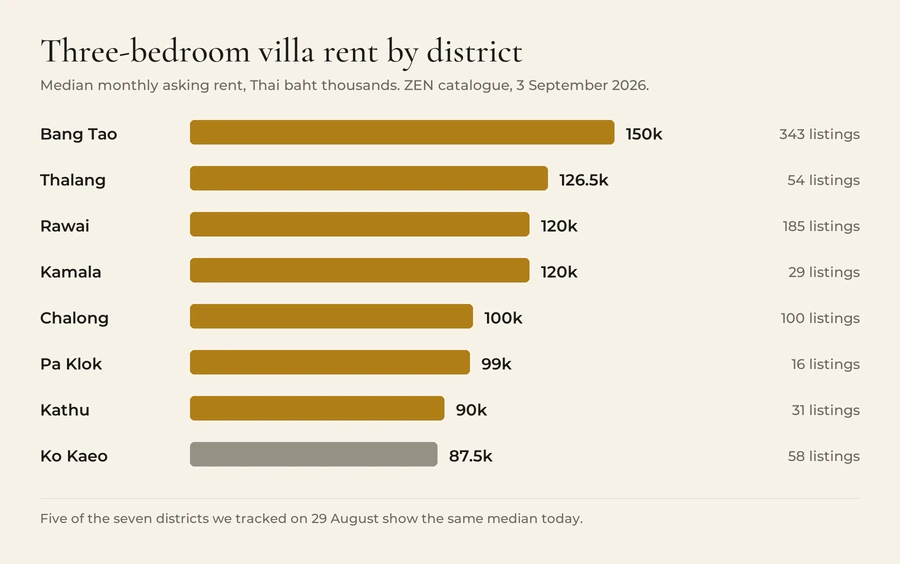
| District | Median rent | Listings | vs 29 August |
|---|---|---|---|
| Bang Tao | ฿150,000 | 343 | unchanged |
| Thalang | ฿126,500 | 54 | −1.9% |
| Rawai | ฿120,000 | 185 | unchanged |
| Kamala | ฿120,000 | 29 | unchanged |
| Chalong | ฿100,000 | 100 | unchanged |
| Pa Klok | ฿99,000 | 16 | new to table |
| Kathu | ฿90,000 | 31 | unchanged |
| Ko Kaeo | ฿87,500 | 58 | +2.9% |
Island-wide, the ladder by size is ฿50,000 for a one-bedroom (25 listings), ฿89,000 for two (222), ฿120,000 for three (854), ฿170,000 for four (522), ฿250,000 for five (155) and ฿300,000 for six (45). The step from three to four bedrooms is the expensive one, and it is where most family budgets get tested.
The spread inside a district is wider than the gap between districts. Bang Tao's middle 50% of three-bedroom villas runs from ฿110,000 to ฿190,000. Rawai's runs from ฿90,000 to ฿137,500. A district median is a starting point for a shortlist, not a price you should expect to pay.
Asking prices on the sale side
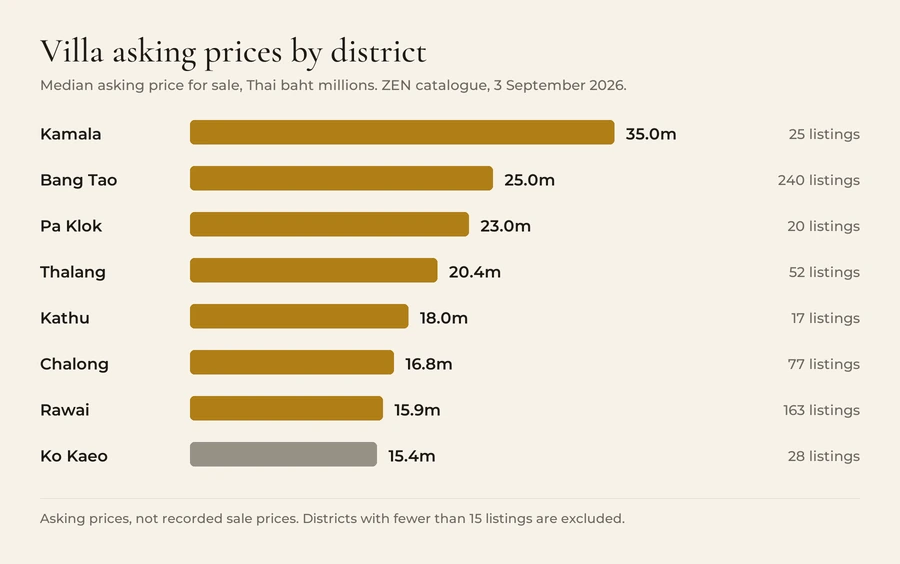
| District | Median asking price | Listings |
|---|---|---|
| Kamala | ฿35.0m | 25 |
| Bang Tao | ฿25.0m | 240 |
| Pa Klok | ฿23.0m | 20 |
| Thalang | ฿20.4m | 52 |
| Kathu | ฿18.0m | 17 |
| Chalong | ฿16.8m | 77 |
| Rawai | ฿15.9m | 163 |
| Ko Kaeo | ฿15.4m | 28 |
Two fifths of everything for sale sits between ฿10m and ฿20m; another 30% between ฿20m and ฿40m. Below ฿10m there are 85 listings — 13% of the sale book — and that thin bottom end is why buyers with a ฿8m budget spend months looking. Above ฿80m there are 43.
Kamala's position at the top of one table and the bottom of the yield ranking is the same fact seen twice: it costs about two and a half times Rawai to buy and rents for the same money. We took that apart in which Phuket areas actually deliver the yield, and nothing this month changes the conclusion.
Where the supply actually is
Phuket is not one market, and it is not fourteen equal ones. Bang Tao alone is 38.5% of our book and Rawai another 22.1%. Together those two districts are more than 60% of everything we have available. Add Chalong and you are at 72%.
That concentration matters more than it looks. It means the island-wide median is mostly a Bang Tao and Rawai number wearing a bigger hat, and it means the districts people ask about most — Kamala, Surin, Kata, Patong — are exactly the ones where the sample is too thin to say much with confidence. When we publish a figure for those, the listing count beside it is the honest part. You can compare the districts yourself on our district pages.
The demand side
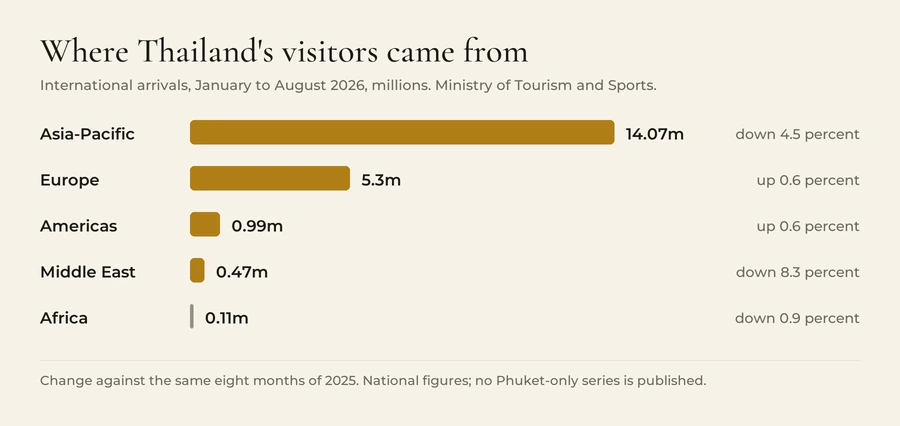
Thailand took 20.94 million international arrivals in the first eight months of 2026, down 3.1% on the same period last year. August alone was down 2.6%. Read only that and you would expect rents to soften.
The regional split says otherwise for Phuket. The entire national decline is South-East Asian: that region is down 14.0% year to date, while China is up 16.1%. The markets that actually sign twelve-month villa leases held. Europe is up 0.6% on the year, the Americas up 0.6%, and Russia — one of Phuket's largest long-stay populations — is down 0.55%, which is flat in all but arithmetic.
One limit worth stating plainly: the Ministry of Tourism and Sports publishes these by nationality and by region, not by destination airport for 2026. There is no Phuket-only arrivals series in the public data, so these are national figures used as a proxy. Treat them as direction, not as a Phuket count.
Money
The Bank of Thailand's Monetary Policy Committee held the policy rate at 1.00% on 26 August, unanimously — the fourth meeting of 2026 and the third consecutive hold. For most foreign buyers in Phuket this is background rather than a lever, since the purchase is usually not financed onshore in baht. It matters indirectly: a low domestic rate and a soft consumption picture are part of why Thai developers have kept building, and why the supply line above keeps refilling.
What it means
If you are renting. The negotiating position is better than it was in August, but not dramatically. More stock at unchanged asking prices means the leverage is in terms rather than headline rent — length, deposit, what is included. October and November are when the high-season squeeze arrives; a lease signed in September is signed into a softer market than one signed in December.
If you are buying. Nothing here argues for hurrying. Asking prices are static across a fortnight in which inventory rose on both sides, which is not the shape of a market about to run away. It is the shape of one where a serious offer gets taken seriously. The scarce thing is not villas; it is villas under ฿10m and villas in the three thin western districts.
If you are letting a villa. Your competition grew by roughly one listing in forty this fortnight while the median asking rent did not move. Pricing at the district median in a district with three hundred competitors is a slow strategy.
We will run this again at the start of October with the same method and the same sample floors, so the month-over-month comparison is real rather than reconstructed. Browse what is available now, or look through the projects and districts behind these numbers.