
Every Phuket villa brochure that mentions leasehold prints the same three numbers: 30 + 30 + 30. Ninety years. For two decades nobody in this market had a pressing reason to interrogate it.
Then came Supreme Court decision 4655/2566 — handed down in 2023, publicised across the market in early 2025. A Phuket lease signed in May 1990 — thirty years, with two further thirty-year terms agreed and paid for up front — reached the end of its first term in 2020. The lessor asked the lessee to leave. The lessee produced the renewal agreement and the receipt for ninety years of rent. The court ordered the lessee out.
That judgment did not change the law. It applied it. But it removed the last comfortable ambiguity from a structure a great many foreign buyers here are holding, and it is worth being exact about what it means — and about what it does not.
What the Code actually says
The duration of a hire of immovable property cannot exceed thirty years. If it is made for a longer period, such period shall be reduced to thirty years. The aforesaid period may be renewed, but it must not exceed thirty years from the time of renewal.
Civil and Commercial Code, Section 540
Two sentences, and the second is the one the market misread. Renewal is expressly permitted. It is capped at thirty years — and it runs from the time of renewal. That last phrase is doing the work. Renewal is an act performed at the end of a term, by the person who owns the land then. It is not something that can be completed in advance and banked.
A second section decides whether any lease is enforceable at all:
A hire of immovable property is not enforceable by action unless there be some written evidence signed by the party liable. If the hire is for more than three years or for the life of the letter or tenant, it is enforceable only for three years unless it is made in writing and registered by the competent official.
Civil and Commercial Code, Section 538
Over three years, register it at the Land Office or it is worth three. That part is well understood and, on the villas we handle, generally done properly. It is the layer above it that fails.
A renewal clause is a promise, not a property right
Your registered thirty-year lease is a right in the land. It is endorsed on the title deed, and Section 569 provides that a hire of immovable property is not extinguished by a transfer of ownership — the new owner steps into the old owner's shoes and inherits the duty. Sell the land under a registered lessee and the lessee stays.
The renewal clause is not on the deed. It cannot be: there is nothing to register until a renewal is actually granted. It is a personal covenant, and it carries exactly as far as a personal covenant carries — to the person who gave it, for as long as they are the owner and alive.
| What you hold | Who it binds | Authority |
|---|---|---|
| The registered 30-year lease | The lessor, their heirs, and any future owner of the land | CCC s.569 |
| A promise to renew, not yet accepted | Only the person who gave it — not a purchaser of the land | Dika 6763/2541 |
| "The lessor will consider an extension" | Nobody. It records a discretion, not an obligation | Dika 3263/2535 |
| A renewal accepted before expiry | The lessor — and a court may order it registered | Dika 1051/2514, 748/2533 |
| Pre-agreed renewals running to 60 or 90 years | Void | Dika 4655/2566 |
| Staying on after expiry, unopposed | Creates a lease of indefinite duration, terminable on notice | CCC s.570 |
Read the fourth row as carefully as the fifth. A renewal option is not worthless. Accepted in time, on terms the parties then agree, it becomes an ordinary obligation and the courts will enforce it. What it is not is automatic, and what it does not do is follow the land.
Four ways the arrangement fails before you reach year 31
- The land is sold. Section 569 carries your registered lease across to the buyer. It does not carry the renewal promise, which was never a right in the land — a new owner is not bound by their predecessor's unaccepted promise to extend. Thirty years is a long time for a parcel to stay in one family's hands.
- The lessor dies before you accept. An unaccepted offer to renew is personal to the person who made it, and it can lapse with them. You are then negotiating with heirs who owe you the lease and nothing else.
- You accept too late. Where the clause sets no window, acceptance must reach the lessor before the original term runs out. Miss the date and there is nothing left to accept.
- You die. A lease is a personal right in Thai law and the Supreme Court has held that it ends on the lessee's death — the heirs do not take it automatically. Where the contract expressly permits the lessee to transfer or sublet, a full-bench decision has allowed heirs to inherit the balance of the registered term. That clause is not standard. Check whether yours has it.
None of these is exotic. Over a thirty-year horizon, at least one of them is likely.
So price it at thirty
Here is the part the alarm leaves out. A thirty-year lease with nothing after it is still, on our own numbers, a rational way to house yourself in Phuket. It has to be priced as what it is: three decades of occupation, bought in advance, with no residual.
The median asking price across the 534 priced, available villas on our sale book on 27 August 2026 is 21,900,000 baht. Spread over thirty years that is 730,000 baht a year, or about 60,800 a month. Spread over the ninety years the brochure promised, it would have been 243,000 a year. The gap between those two numbers is the entire commercial content of this article.
Set the thirty-year figure against what the same villa rents for, bedroom for bedroom:
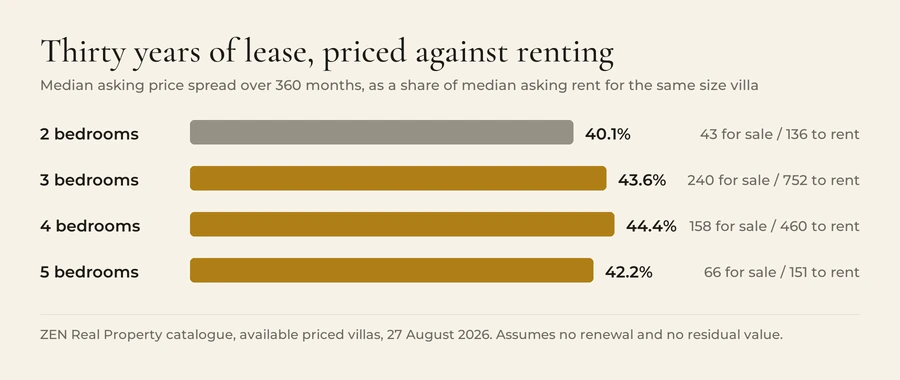
| Villa size | Median asking price | Price over 360 months | Median asking rent | Share of rent |
|---|---|---|---|---|
| 2 bedrooms | ฿13,000,000 | ฿36,111/mo | ฿90,000/mo | 40.1% |
| 3 bedrooms | ฿18,850,000 | ฿52,361/mo | ฿120,000/mo | 43.6% |
| 4 bedrooms | ฿28,800,000 | ฿80,000/mo | ฿180,000/mo | 44.4% |
| 5 bedrooms | ฿37,950,000 | ฿105,417/mo | ฿250,000/mo | 42.2% |
Medians across 507 priced, available villas for sale and 1,499 priced, available villas to rent at these bedroom counts, 27 August 2026. Sale and rental medians are drawn island-wide, so a district that is cheap to rent and dear to buy is blended in with one that is not.
On the assumption that the lease is worth nothing after year 30 — the most pessimistic assumption available — buying costs somewhere between 40% and 44% of renting the same villa. The consistency across four bedroom counts is the useful part: this is not an artefact of one segment. It also excludes the running costs a lessee carries and a tenant usually does not, and it says nothing about what else the capital could have done in thirty years. It is a housing comparison, not an investment case.
The point stands anyway. You do not need the renewal for the arithmetic to work. You need it not to have been priced in.
What to ask for instead
- Get the thirty years registered. Everything else in this article is secondary to that endorsement on the deed.
- Do not pay for years 31 to 90. If the price was built on ninety years of tenure, the price is wrong. Negotiate on thirty.
- Ask for an option, not an automatic renewal. A right to require a fresh thirty-year lease, exercisable in a defined window before expiry, with the rent set by a stated mechanism rather than fixed in 2026. This is what the courts have consistently been willing to enforce.
- Get a transfer and succession clause. Express permission for the lessee to assign or sublet is what lets heirs take the balance of the term. Without it, the lease is personal and it ends with you.
- Own the house. Buildings are legally separate from the land beneath them. The structure can sit in your own name, and its value at the end of the term is a real thing to negotiate over.
- Ask what happens if the land is sold. A first right of refusal, or a superficies registered alongside the lease, gives the promise something to hold onto. A clause that binds only the current owner will not survive them.
- Consider the shape, not just the term. Section 541 permits a hire made for the life of the lessor or the lessee, and Section 538 contemplates registering exactly that. It ends on that death and leaves heirs nothing — not a substitute for a term, but worth putting to your lawyer.
And the 99-year proposal
An extension of the maximum lease term from thirty years to ninety-nine has been under discussion since 2024. It would need amendments to the Civil and Commercial Code and the Land Code, and as of today it is a draft. It has not passed.
Treat any villa advertised on ninety-nine years as advertised on thirty. If the law changes, a well-drafted option costs you nothing and you renegotiate from a better position. If it does not, you have not paid for something that was never delivered.
Nothing here argues against leasehold. We sell it, clients live in it happily, and the numbers above are the reason. What it argues against is paying a ninety-year price for a thirty-year right — which is a valuation error, not a legal one, and the only one of the two you can still fix at the negotiating table.
If you want a specific villa's lease read properly before you commit to it — the registration, the renewal wording, the succession clause, who actually owns the land — tell us what you are looking at and we will go through it. You can also browse the developments we work with, or read our breakdown of every fee between offer and keys, which costs the lease route line by line.