

Healthcare is the thing most people moving to Phuket settle last, and usually in a hurry. It is also one of the few parts of living here with a legal floor under it: if you are over fifty and on a retirement visa, Thai law tells you how much medical cover you must hold, and that figure went from 400,000 baht to 3 million in 2021.
This is what the island actually has, what the rules actually require, what the three routes to cover cost — and, the part usually left out, which prices are published and which are not.
Where you would actually be treated
Phuket's serious medicine sits in one corner of the island. Every hospital in the table below is in Mueang Phuket, the eastern district built around Phuket Town.
| Hospital | Sub-district | What it is |
|---|---|---|
| Vachira Phuket | Talat Yai | Government. 650 beds; describes itself as a tertiary-level central hospital |
| Bangkok Hospital Phuket | Talat Yai | Private. 200 beds and more than 30 specialist centres; JCI and Thai HA accredited; open 24 hours |
| Bangkok Hospital Siriroj | Wichit | Private. JCI accredited; founded 1982 |
| Dibuk | Wichit | Private, BDMS group. 24-hour emergency department |
| Mission Hospital Phuket | Phuket Town | Private, not-for-profit, run by the Seventh-day Adventist church; new two-tower campus opened 2023 |
Two of those hold accreditation from Joint Commission International, and only two. JCI's own register lists Bangkok Hospital Phuket with an effective date of 23 May 2009 and Bangkok Hospital Siriroj with 15 December 2012, and nothing else in the province. If you have seen a list naming three JCI hospitals in Phuket, it has probably counted one of them twice: Siriroj's own history page says the hospital was "known in earlier years as Phuket International Hospital and Siriroj International Hospital", and both older names still circulate as though they were separate institutions.
The government network reaches beyond Phuket Town — the provincial health office runs Thalang Hospital in the north and Patong Hospital on the west coast alongside Vachira — but anything past a community hospital's scope is referred east.
That is not where the rental market is
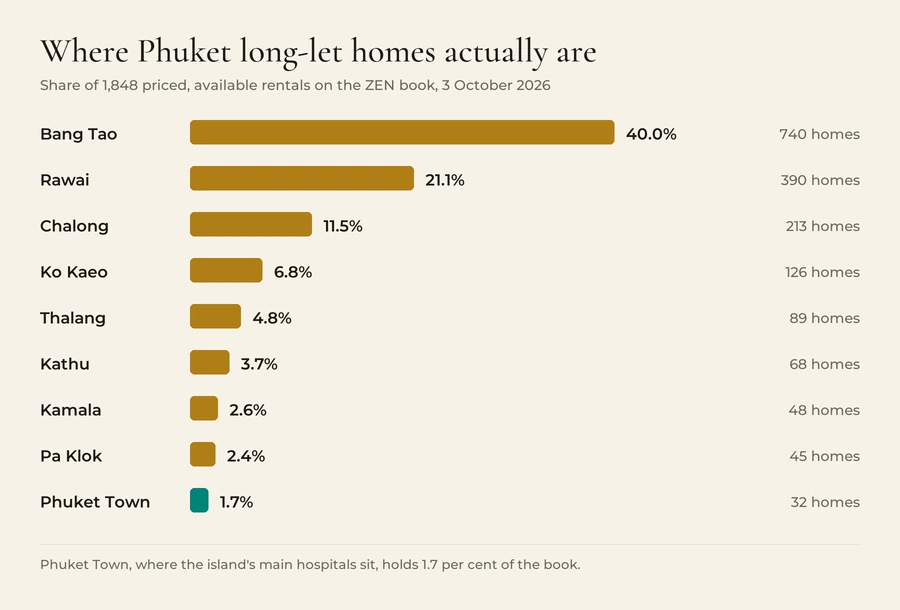
Forty per cent of our long-let book is at Bang Tao on the north-west coast, and another 21% at Rawai in the south. Phuket Town itself is 1.7% — 32 homes out of 1,848 priced and available listings. Rawai, Chalong and Ko Kaeo are at least in the same administrative district as the hospitals. Bang Tao, which holds more of our rental stock than everywhere else combined, is on the other side of the island.
We cannot turn that into minutes for you, and we will not pretend otherwise. Our catalogue geocodes each listing to its area's reference point rather than to the house, so any drive time calculated from it would be invented precision. What we can say is that the gap exists, that it is real, and that it is worth driving yourself — at the hour you would actually be driving it, not on a quiet Sunday — before you commit to a year somewhere.
The three ways people cover it
Thailand's own visa rules assume a foreign resident is covered either privately or through Thai social security — the Board of Investment names exactly those two as the alternatives to parking a large cash deposit. In practice everyone here ends up on one of three routes, and plenty of households use more than one.
| Route | Who it is for | What it costs |
|---|---|---|
| Thai social security, Section 33 | Anyone employed in Thailand on a work permit. Contributions are compulsory | 5% of wages from you and 5% from your employer, on a wage base capped at ฿17,500 a month since 1 January 2026 — so ฿875 a month at most, each |
| Private medical insurance | Retirees, the self-employed, families, anyone who wants to choose the hospital | Not published. Every insurer we checked quotes individually |
| Paying as you go | Short stays, and people with substantial assets who have decided to carry the risk | Not published either — see below |
At ฿875 a month Section 33 is cheap, and it is the route most often overlooked, because it arrives automatically with a job and is deducted before anyone reads about it. The ceiling moved this year: the wage base used to calculate contributions rose from ฿15,000 to ฿17,500 a month on 1 January 2026, the first change in more than three decades, taking the maximum monthly contribution from ฿750 to ฿875 on each side. It is scheduled to rise again, to ฿20,000 in 2029 and ฿23,000 in 2032. The catch is that Section 33 treats you at your registered hospital, which you nominate and which will not be a private international hospital.
What your visa makes you hold
Most Thai visa categories carry no insurance requirement at all. The long-stay ones do, and there is an official purchase portal for them run by the Thai General Insurance Association, covering the one-year O-A, the ten-year O-X and the Special Tourist Visa; the Ministry of Public Health's guideline names sixteen approved Thai insurers. The Long-Term Resident visa sits outside that portal with its own requirement, set by the Board of Investment. The two that matter to most people moving here are the O-A and the LTR.
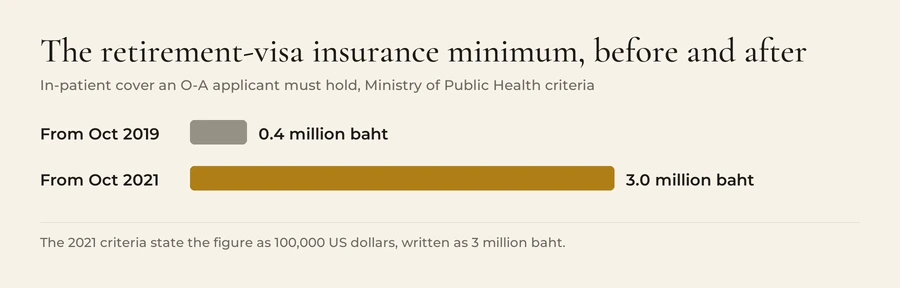
The Non-Immigrant O-A, the one-year retirement visa, is the demanding one. The Ministry of Public Health's published criteria require an applicant to be fifty or over, to show either income of at least ฿65,000 a month or a Thai bank deposit of at least ฿800,000, and to hold medical insurance. That insurance requirement started at ฿400,000 of in-patient cover plus ฿40,000 of out-patient cover on 31 October 2019. From 1 October 2021 it became cover for all medical expenses of not less than 100,000 US dollars, which the criteria themselves write as 3 million baht. Cover bought abroad is now accepted, but the certificate has to be authenticated — either by an embassy in Thailand or by a notary approved through the applicant's own foreign ministry.
There is a route for people no insurer will take. An applicant who is refused cover can instead produce the insurer's letter of denial together with evidence of property, bank deposits or other cover totalling not less than 3 million baht. It is a real provision in the published criteria, and it is the answer to the problem that made the old rule unworkable: Thai insurers would not sell to applicants over seventy.
The Long-Term Resident visa is lighter. The Board of Investment's own requirement is health insurance covering a minimum of 50,000 US dollars, or current Thai social security benefits, or a maintained bank balance of at least 100,000 US dollars. Dependants are set at 25,000 US dollars each on the deposit route. The point worth noticing is the middle option: if you are already in Section 33 through work, the LTR takes that instead of a policy.
The numbers nobody publishes
Here is the honest gap. We could not find a published general tariff for any private hospital in Phuket, and we looked. What the hospitals publish on their own websites is screening and wellness packages — a mammogram, a brain health programme, a check-up — priced individually and refreshed as promotions. What an admission, a scan, a night in a bed or an operation costs is quoted on the day, to you.
Insurance is much the same. Pacific Cross and AXA, two of the insurers approved for long-stay visas, both publish their benefit schedules and neither publishes a premium; both route you to a quote. Premium tables do circulate on broker and comparison sites, and we have left them out, because we could not stand any of them up against an insurer's own page. Age, medical history and deductible move the number far enough that a table without your details is decoration.
So the two questions worth asking in writing, before you need either answer, are what a hospital will charge for the thing you are most likely to need, and which hospitals your insurer settles with directly rather than reimbursing you later.
Five things that catch people out
- Pre-existing conditions. A policy is written against what you declared, not against what you have. Declare everything, in writing, and keep the reply.
- The policy and the visa are joined. On an O-A, the cover is a condition of the stay. Let it lapse and the extension goes with it.
- Age walls. The reason the O-A rules were rewritten in 2021 is that Thai insurers would not sell to applicants over seventy. Buy earlier than you think you need to, and check the renewal age, not the entry age.
- The deposit at admission. A private hospital may ask for a payment guarantee before non-emergency treatment. A direct-billing arrangement with your insurer avoids producing a card at a bad moment.
- Social security is not portable. It treats you at the hospital you nominated. Useful, cheap, and not a substitute for a policy if you want to walk into Bangkok Hospital Phuket.
A checklist before you move
- Work out which route you are on: employed and in Section 33, insured privately, or self-funding.
- If you are applying for an O-A, get the cover in place before the application, not after — and confirm whether your insurer is on the Thai General Insurance Association's approved list or whether your foreign certificate will need authenticating.
- Ask your insurer for its Phuket direct-billing list in writing. Check that the hospital you would choose in an emergency is on it.
- Register with a hospital before you need one. Get a patient number and put the emergency line in your phone.
- Drive from the house you are considering to Vachira and to Bangkok Hospital Phuket, at a realistic hour.
Which brings it back to where you live
None of this makes the east side of the island the right place to rent. Bang Tao and Rawai are where the stock, the schools and the beaches are, and that is why 61% of our long-let book sits in those two areas. But the journey to a hospital is a real input into choosing between areas, and it is an easy one to leave out until the first time it matters.
Our long-term rental listings carry the area on every property, so you can see what each part of the island asks before you narrow down. If you would rather talk it through with someone who knows the drive, get in touch and we will go through it with you.