
An off-plan villa is bought in instalments against a house that does not exist yet. For most of the build, the developer holds a large share of your money and you hold a piece of paper. Whether that paper is worth anything depends on what it says, who signed it, and which Thai laws stand behind it. None of that is visible in a brochure.
This article sets out what actually protects an off-plan buyer in Phuket and what does not. It covers the deposit rules in the Civil and Commercial Code, the standard contract for licensed estates, the advertising rules, and escrow. It is not legal advice. It is written so that you know what to ask your own lawyer, and what a missing answer means.
A disclosure first. ZEN sells off-plan villas, including the Botanica projects we have reviewed on this Journal, and we are paid by the seller. Every rule below comes from a published Thai text, listed at the foot of the page, so none of it depends on trusting us.
What is at stake
Developers publish their payment schedules unevenly, so we cannot give you a market-wide figure. The one below comes from a developer price list we read for our Foresta II review. Its shape is the thing to understand: small to reserve, large to sign, then instalments tied to construction stages.
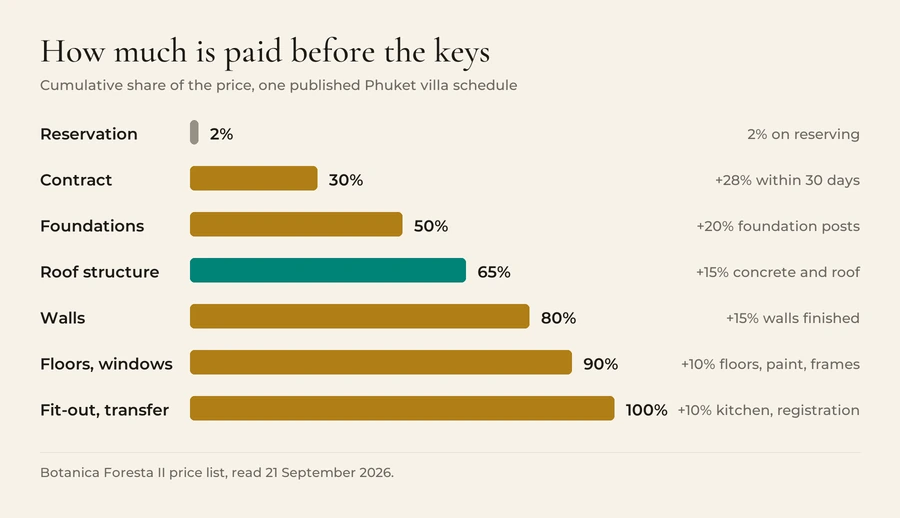
| Stage | Instalment | Paid so far |
|---|---|---|
| Reservation | 2% | 2% |
| Contract, within 30 days | 28% | 30% |
| Foundation posts finished | 20% | 50% |
| Concrete and roof structure | 15% | 65% |
| Walls finished | 15% | 80% |
| Floors, paint, windows, door frames | 10% | 90% |
| Fit-out, transfer and registration | 10% | 100% |
Put a price on it. On 29 September 2026 our sale book held 599 priced, available villas. The 185 of them listed inside a named project — 30.9% — had a median asking price of ฿28,900,000. On that price, this schedule has ฿8,670,000 out of your account within about a month of reserving, and ฿18,785,000 by the time the roof goes on. Our catalogue does not record which villas are finished and which are not, so treat that median as a sense of scale, not as an off-plan price.
1. Until the Land Office registers it, you own nothing
This is the fact the rest of the article hangs on. Under Section 456 of the Civil and Commercial Code, a sale of land or a house is void unless it is made in writing and registered with the competent official. Section 1299 says acquiring land, or a real right in it, by contract is incomplete without the same writing and registration. What you sign off-plan is not a sale. It is an agreement to buy — a สัญญาจะซื้อจะขาย — which Section 456 lets you enforce in court if there is written evidence signed by the developer, or a deposit, or part payment.
So during the build you have a claim against a company, not a house. If the company is sound, that claim is worth the house. If it is not, you are one creditor among several. Everything below is about making the claim as strong as possible, and keeping the amount riding on it as small as possible for as long as possible.
Foreign buyers have one more step to watch. Most take a registered land lease rather than freehold, and Section 538 says a lease of more than three years that is not in writing and registered can be enforced for three years only. The lease is registered at completion, not at reservation. Our article on how foreigners actually hold Phuket property sets out the structures.
2. Know what a deposit means in Thai law
Section 377 treats a deposit, มัดจำ, as evidence the contract was made and as security for performing it. Section 378 then sets the default rules, which apply unless the contract says otherwise:
- If the contract is performed, the deposit is returned or counted toward the price.
- If you fail to perform, or the contract is rescinded through your fault, the deposit is forfeited.
- If the developer fails to perform, the deposit is returned.
Two things follow. The words "unless agreed otherwise" mean the reservation form can rewrite those rules, so read it before you pay, not after. And forfeiture is not unlimited: Section 383 lets a court reduce a forfeited penalty it finds disproportionately high. Whether a particular clause counts as a deposit or a penalty is a question for your lawyer, and a court case is a remedy, not a plan.
3. Find out whether the estate is licensed — it decides your contract
The Land Development Act B.E. 2543, also translated as the Land Allocation Act, covers the sale of land divided into ten or more plots, or fewer than ten that grow to ten or more within three years. Section 21 prohibits selling without a licence. We covered the licence search and the utility servitudes in the checks to run before you sign. For an off-plan buyer, the licence matters for a further reason: it brings a fixed contract with it.
Section 34 requires the contract between developer and buyer to follow the form set by the Central Land Development Committee. Any part of a contract that departs from the form and is less favourable to the buyer has no effect. The form for land with a building — Form ข, in the Department of Lands' compilation — says, among other things:
- Clause 1: the seller states its land development licence number and date.
- Clause 4: instalments may be tied to fixed dates or to construction stages, each with a completion date, and transfer needs at least 30 days' notice.
- Clause 7: the seller either states its building permit number or must apply for one within a set number of days and show you the evidence. You or your representative may inspect the site during working hours.
- Clause 10: if transfer is late and you do not cancel, the seller pays a daily penalty of at least 0.01% of the price, capped at 10% in total.
- Clause 11: the seller answers for structural defects for five years from transfer, and for fixtures, fences and walls for one year.
- Clause 14: you may cancel if the seller breaches any clause. The seller may cancel only after missed instalments and 30 days' written notice.
- Clause 15: if you cancel, you may claim back everything you have paid, with interest from each payment date, plus damages. If the seller cancels, it may keep only its actual loss and must refund the rest within 30 days.
The Act adds three more protections. Section 35 requires a signed receipt for every payment. Section 36 requires the plot to be transferred free of mortgage, and lets you pay the mortgagee directly out of the price if it is not. Section 24 requires a bank guarantee where roads and utilities are unfinished when the licence is granted, so that the committee can complete them if the developer does not.
Look closely at clause 10. At the minimum rate of 0.01% a day, the 10% cap takes a thousand days to reach. On a ฿28,900,000 villa, the minimum is ฿2,890 a day. That is a floor, and the rate in your contract can be higher — negotiate it before you sign, because it is the only number that prices the developer's delay.
Two limits to know. A project of fewer than ten plots is outside the Act by Section 4's own definition, and outside the form with it. And the form is written for a sale. A foreign buyer taking a registered lease may sign a lease and a building agreement instead, and it is not obvious that Section 34 reaches either. Ask your lawyer, in writing, which of the protections above your documents carry across.
4. Read the advertisement as a checklist
A Ministerial Regulation of 2021 under the Consumer Protection Act, clause 10, treats an advertisement for sub-divided land — land alone or land with a building — as unfair if a printed or online version leaves out any of the following. That list is the most useful due-diligence prompt an off-plan buyer is given for free.
- The land's location, title deed number and area, and the land development licence number where a licence is required.
- Whether the land and building are encumbered.
- The month and year construction starts, and the month and year it is due to finish.
- When ownership will be transferred once the price is paid.
- The names of the developer, the landowner and the seller, and for a company its registered and paid-up capital and its authorised directors.
- Whether the images are real or simulated.
Section 29 of the Land Development Act adds that a licensed project's advertising must match its licence application. Our own review of Foresta II found no completion date published anywhere in the developer's public material. If you cannot find these items, ask for them in writing before you reserve.
5. Escrow exists — and it is optional
Thailand has had an escrow law since 2008, the Act on Protecting the Interests of Contracting Parties B.E. 2551, known in English as the Escrow Act, amended in 2019. It is voluntary. Section 5 says the parties may agree to appoint an escrow agent, and we found no rule that makes escrow compulsory for an off-plan house or villa.
Where it is used, it is strong:
- Only a financial institution, or another company named by ministerial regulation, may act as agent, under a licence from the Minister of Finance (Sections 3, 9 and 10).
- The agent holds the money in a separate account for that contract (Sections 14 and 17), and fees may not be taken out of it (Section 8).
- For land with a title deed, the agent tells the Land Office, which bars registration of a transfer until the agent releases it (Section 17).
- Money is released only when the conditions are met and there is no dispute (Section 19). In a dispute, it stays put until the parties agree or a court decides (Section 23).
- Escrow money cannot be seized by the agent's creditors and is not part of its estate in bankruptcy (Section 25).
The Fiscal Policy Office's published list of licensed agents names eight banks and is dated August 2019. We found no newer list, so ask the bank directly whether it offers the service today. Ask the developer whether it will use escrow, for the contract instalment at least. The answer tells you something either way.
Five ways buyers lose money off-plan
- Paying the reservation before reading the reservation form. Section 378 applies unless agreed otherwise, and the form is where "otherwise" is written.
- Instalments tied to dates, not stages. Clause 4 of the standard form allows both. A date-based schedule keeps falling due whether or not the house is rising.
- A stage certified only by the developer. Clause 7.4 gives you the right to inspect. Use it, or send someone, before paying each stage.
- A project of nine plots. Below ten, the standard form, the receipt rule and the utilities guarantee do not apply. Count the plots on the layout plan.
- Buying the brochure rather than the record. Developers publish conflicting documents. Our Foresta II review found three specifications that could not be reconciled. The dated list attached to your contract is the one that binds.
The checklist
- A reservation form that says what happens to the money if due diligence fails or the contract is never signed.
- The land development licence, found on the Department of Lands search, and a count of the plots.
- A Land Office search of the plot: who owns the land, and what mortgage sits on it.
- The developer company on the DBD DataWarehouse: active, the right directors, filed accounts.
- The building permit number, or the contract clause that obliges the developer to obtain one.
- A contract checked against the Committee's form, with instalments tied to stages and a late-delivery penalty you have negotiated.
- For a lease, your lawyer's written view on which protections your documents carry across.
- A signed receipt for every payment, and a site visit before every stage payment.
- The escrow question, asked, and the answer kept.
- A delivered earlier phase by the same developer, visited in person.
Off-plan can be the right way to buy: first choice of plot, and a house finished to your choices. It is also the purchase where the paperwork does the most work. If you are weighing a project, see what is on our book, or tell us what you are looking for and we will send finished villas alongside the off-plan ones, so you can compare the two honestly.