
Families who ring us about UWC Thailand have usually already decided they like the idea of it. What they want from us is the unromantic half: what it costs in total, what the fee does not include, and whether the academic record justifies the number.
Every figure below comes from the school's own published documents — the 2026/2027 fee schedule, the 2026/2027 school profile, its results page and its calendar — or from the IB's own register of authorised schools. Where the school publishes nothing, we say so rather than estimate, and there is more of that than you might expect.
The short version: on the IB register, UWC Thailand is the only school in Phuket authorised to run all three IB programmes, and its Diploma cohort has finished above the worldwide average in every one of the last ten years. It also sits near the top of the island's fee table — at ฿933,000 for Grades 11 and 12 only BISP charges more among the schools actually teaching that stage — and the fee is unusually inclusive in some places and unusually silent in others.
What we checked, and what we did not
This is a review against stated criteria: curriculum and authorisation, accreditation, published fees, published results, the size and composition of the school, boarding, the calendar, and what it costs to live within reach of the campus.
We did not survey parents, and there are no quotes from families here — there is no honest way to sample opinion at a 557-student school, so we have not tried. The cross-school fee comparison already lives in our guide to Phuket's international schools for 2026/27.
The school in one table
| Criterion | Published position |
|---|---|
| Curriculum | IB continuum — PYP from Pre-Kindergarten to Grade 5, MYP Grades 6–10, Diploma Grades 11–12 |
| IB authorisation | IB school since 18 June 2012. PYP authorised 18 June 2012, DP 9 April 2014, MYP 26 June 2014. IB school code 006309 |
| Career-related Programme | Not offered |
| Ages | Age 2 to Grade 12 |
| Enrolment | 557 students — 206 PYP, 196 MYP, 155 Diploma |
| Staff | 119 education faculty, 63 support staff |
| Nationalities | 65 national identities |
| Boarding | Day, occasional and full (seven-day) boarding |
| Accreditation | UWC, Council of International Schools, IB World School, EARCOS, ISAT, Athlete Friendly Education Centre, ISS, Duke of Edinburgh, ONESQA |
| Structure | Non-profit foundation school, three-board governance |
| Location | Thepkasattri, Thalang |
| Academic year | Two semesters. 17 August 2026 to 18 December 2026, then 11 January 2027 to 18 June 2027 |
Two details there are worth pausing on. The staffing ratio — 557 students against 119 teaching faculty, roughly one educator for every five children — is what the fee is really buying. And the calendar runs two semesters where most British-curriculum schools here run three terms, starting on 17 August, a week before BISP. If you are moving mid-year or holding two children at two schools, those dates will not line up.
What it costs
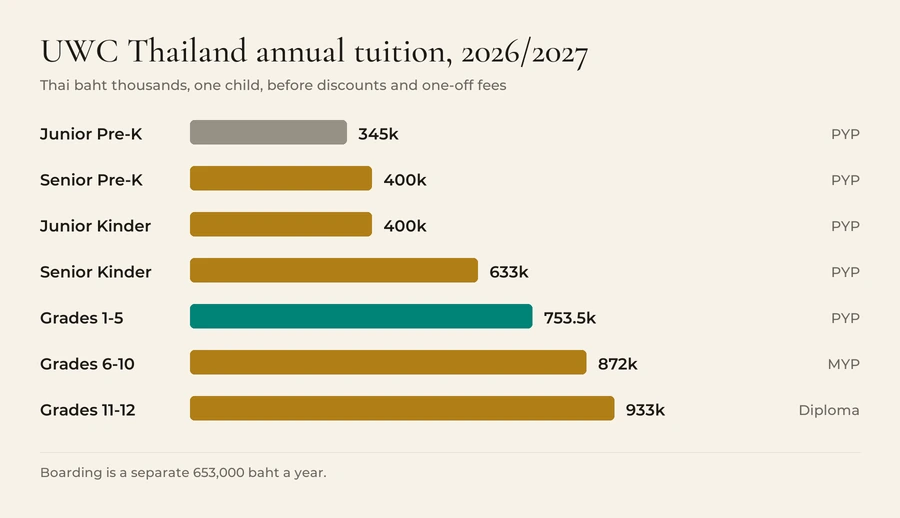
Tuition for 2026/2027, as published, one child, before any discount:
| Stage | Annual tuition |
|---|---|
| Junior Pre-Kindergarten (Mini Mantas 2) | ฿345,000 |
| Senior Pre-Kindergarten (Mini Mantas 3) | ฿400,000 |
| Junior Kindergarten | ฿400,000 |
| Senior Kindergarten | ฿633,000 |
| Grades 1 to 5 | ฿753,500 |
| Grades 6 to 10 | ฿872,000 |
| Grades 11 to 12 | ฿933,000 |
| Boarding service | ฿653,000 |
Then the one-off fees, which is where the first-year number is made:
| One-off fee | Amount | Refundable |
|---|---|---|
| Application fee | ฿7,000 | No |
| Placement fee | ฿100,000 | No |
| School Development Fund — one child | ฿165,000 | No |
| School Development Fund — two or more children | ฿220,000 | No |
| Security deposit | ฿25,000 | Yes, less any outstanding payment |
| Manta Staff-Parent Association, annual | ฿500 | No |
The School Development Fund is the one that surprises people. It is a once-off family contribution towards the UWC global scholarship requirement, it is explicitly not returned, and it is charged per family rather than per child — the only fee on the schedule the school states that way. Everything else reads as per student without quite saying so, so if you are enrolling two children at once, get the application and placement fees confirmed in writing before you budget.
Put together, a single child entering Grades 1 to 5 costs ฿1,026,000 in non-refundable fees in year one — ฿753,500 of tuition, ฿272,000 of one-off charges and the ฿500 association fee — then ฿754,000 in every year after that. With the refundable deposit it is ฿1,051,000 of cash out of the door.
At the top of the school the arithmetic is harder. Grades 11 to 12 with full boarding is ฿1,586,000 a year, so a Diploma student arriving as a new boarder is about ฿1,858,500 in year one, before a uniform is bought. Sibling discounts apply to tuition only — 5% for a second child, 15% for a third, 25% for a fourth, 50% for a fifth — and only while the children are enrolled at the same time.
Two more charges sit in the payment terms rather than the fee table. Late payment costs ฿20,000 at one to thirty days, ฿40,000 at thirty-one to sixty and ฿60,000 at sixty-one to ninety. Credit card and WeChat payments carry a 3% transaction fee, roughly ฿47,600 on a Diploma boarder's annual bill — pay by transfer.
None of this applies to students nominated through a UWC National Committee or the Global Selection Programme. That is a separate, needs-assessed route into the two-year Diploma, and the schedule says plainly that it does not cover them.
What the fee does and does not cover
Worth reading twice, because the school is genuinely more inclusive than its competitors in one direction and quieter than them in the other.
Inside the fee. Food, and not optionally: the school provides a morning and afternoon snack and a buffet lunch, states that "the school food is mandatory and the cost is included in your child's fees", and does not permit students to bring their own. Boarders also get weekday breakfast, dinner and all weekend meals. Core off-campus learning trips are included too — Experiential Learning trips, grade-level camps and expeditions.
Outside the fee. Uniforms, bought by parents through the school's own shop. External examination entry, which the school lists as including the IB Diploma, MPSAT, SAT and TOEFL. The optional bus. Significant special educational needs, costed case by case. The Accelerated English Language Acquisition programme, billed in cycles. Some co-curricular activities, and travel for competitive sports teams.
Three of those are unpriced on any public page — language support, learning support and transport. They are the three that most often decide whether a family can afford a school, and the three you will have to ask for in writing.
The results
The school publishes a ten-year run of Diploma averages beside the worldwide average for the same year, which is more transparency than most schools here offer.
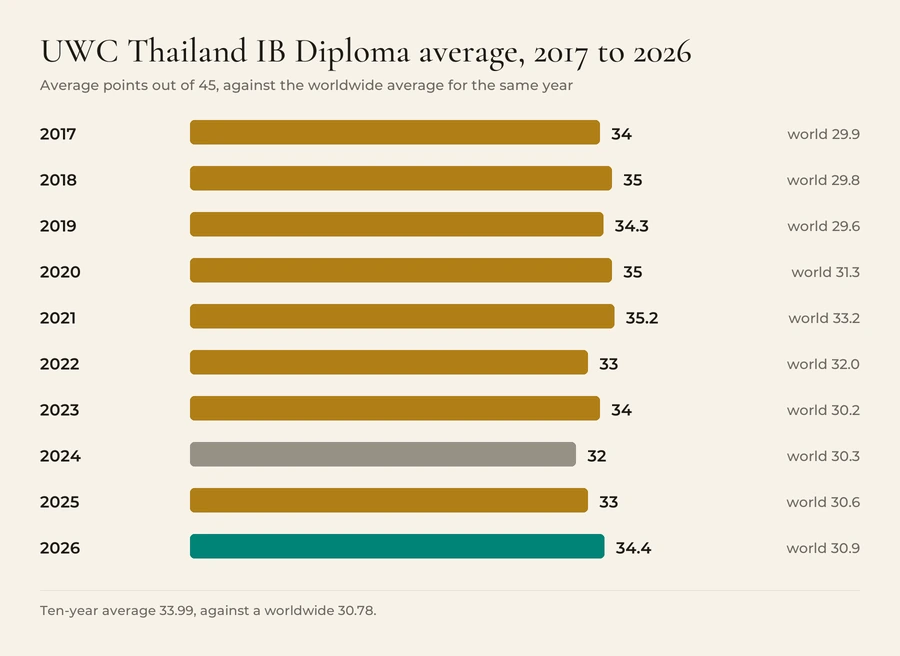
The record is consistent rather than spectacular, and consistency is the more useful quality: above the worldwide average in all ten years, with a ten-year mean of 33.99 against 30.78. The margin is not stable, though — more than five points in 2018, and 1.7 points in 2024, the school's weakest year at 32. Anyone deciding on a single year's figure is reading noise.
What has changed most is the size of the cohort: 18 students sat the Diploma in 2017 and 83 sat it in 2026. Holding a score while the entry quadruples is the harder achievement, and it is the number we would weight.
One discrepancy to record. The results page gives the 2026 average as 34.4. The school's own 2026/2027 profile says the Class of 2026 "achieved an average International Baccalaureate Diploma Programme score of 34.5 points". Two of the school's own documents, a tenth of a point apart. It changes nothing material, but we would rather print the conflict than quietly pick the better number. Neither document publishes a pass rate, a highest score or a bilingual diploma count, so we cannot give you those.
The cohort is the actual product
The fee buys a classroom that is difficult to reproduce commercially. The school reports 65 national identities across 557 students, and the IB's register shows what that means in practice: UWC Thailand's Diploma students are currently registered for Language A courses — first-language literature — in twenty-five different languages, among them Azerbaijani, Albanian, Macedonian, Mongolian, Somali, Dzongkha, Burmese, Lao, Khmer, Bengali, Ukrainian and Persian, alongside the expected English, Chinese, Thai, Russian, French, German, Spanish and Italian. That is not a marketing claim but a subject registration, and it means a child arriving with an unusual first language has a realistic chance of carrying it to Diploma level here.
The mix comes partly from the National Committee route, which brings needs-assessed students from the wider UWC movement into the Diploma. It is also behind the scholarship figures — graduating cohorts were offered US$10.7m in university scholarships in 2026 against a ten-year average of US$4.69m a year — and the United States is the predominant destination largely because the Davis United World College Scholars Programme funds UWC graduates at 100 American institutions.
Against that, the university counselling carries limits the school states openly and which will not suit everybody: no more than ten applications worldwide per student, no GPA computed and no ranking, and no formal preparation for standardised tests such as the SAT, ACT or TOEFL. A family whose plan turns on a strong SAT will be arranging that themselves.
Boarding, and one register oddity
Boarding is the school's real structural advantage. Of the seven Phuket schools we compared in our schools guide, only BISP also offers it. Three products are described: day boarding, which keeps a student on campus until 9pm with meals, co-curricular activities, supervised study and evening activities; occasional boarding; and full boarding, a seven-day residential programme.
Only one boarding price is published — the ฿653,000 annual boarding service — and the school does not say which of the three it buys. Day and occasional boarding fees come only from the boarding team. If you are weighing day boarding as a way of solving a long school run, get that figure before you sign anything.
One curiosity for anyone checking the paperwork themselves: the IB's register lists the school's boarding facilities as "day" for all three programmes, while the school plainly runs full residential boarding and charges for it. The register says its data comes from the IB's own information system and is maintained by the school's coordinators, so this reads as a stale field rather than a contradiction — but if you searched the register first and concluded the school was day-only, that is why.
Where families live for it
The campus is in Thepkasattri, inland Thalang — not where most people picture themselves when they picture Phuket. On our own book on 12 September 2026, the median asking rent for a three-bedroom home in Thalang was ฿126,500 a month across 54 available listings. Twelve months of that beside Grade 1 to 5 tuition puts the recurring annual cost of one primary child at roughly ฿2.27m. From Bang Tao, where the median three-bedroom asks ฿150,000 across 347 listings, it is about ฿2.55m — and Bang Tao is the deepest rental market on the island, which is why many families accept the drive.
The bus deserves a warning. The school runs one, but it "stops off at certain areas along the west coast of Phuket", the route "depends on the level of interest in this service", and neither routes nor costs are published. You cannot plan a lease around it: confirm the route for your road in writing first, and if it does not serve you, the school run is yours to drive twice a day.
Our long-term rental listings and district guides show what is actually available within reach of the campus at the moment you are looking, rather than when this was written.
The verdict
It suits: a family wanting the IB continuum from the early years to the Diploma without changing schools, for which there is no alternative here. A boarding family, full or day. A child with an unusual first language who wants to carry it to Diploma level. A family that treats a genuinely international cohort as an outcome in itself, and can pay for it.
It suits less well: a family wanting a British curriculum, IGCSEs and A Levels, which the school does not offer. A university plan that turns on formal test preparation. A family that wants a beach-side school run or a published bus route. And anyone whose budget is at its limit at ฿933,000, because the unpriced extras — exams, uniforms, transport, language and learning support — all sit on top of it.
If the school is on your list, the useful next step is deciding where you would live to attend it, because on these numbers the rent is the larger half of the bill at the primary stage. Tell us the campus and the budget and we will send you what is available within a sensible drive of it.