

Rent is the easy number. A Phuket villa advertises one figure a month and everybody quotes it. What the advertisement almost never says is which of the things that make a villa habitable sit inside that figure, and which arrive afterwards as bills.
That gap is where most of the arguments in a first year of renting come from. This is a guide to closing it before you sign: what a listing actually promises, what the meters cost at the published rates, what the services cost, and what Thai law lets a landlord charge you for.
1. Start with what the listing promises, and notice what it cannot tell you
Our rental book held 1,856 priced, available long-term rentals on 22 September 2026, of which 1,568 are villas. Almost all of them come furnished — 1,845 of the 1,856 carry a furnished tag, and exactly two are advertised unfurnished. A private pool appears on 1,561 of the 1,568 villas. Those are genuinely part of the deal.
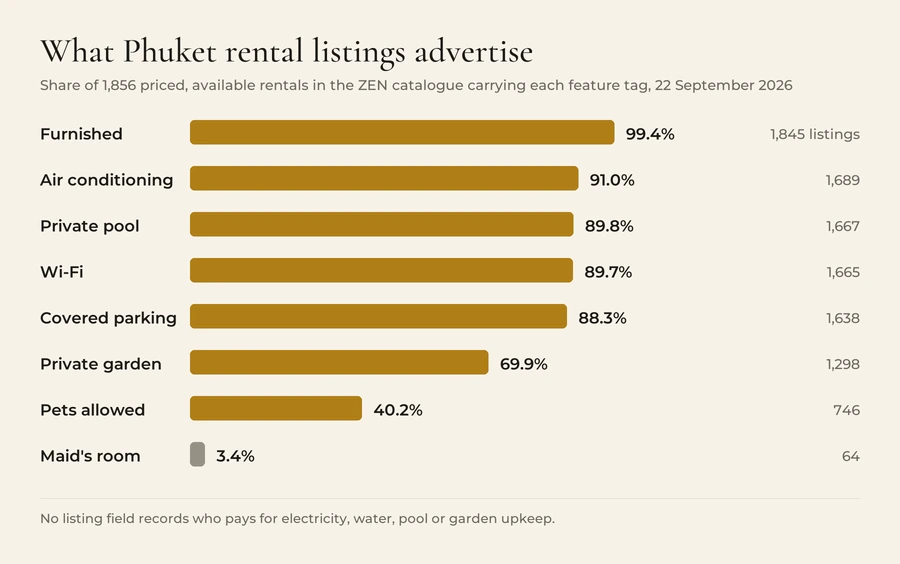
Two warnings about that chart. The first is that a tag is a claim made at listing time by whoever wrote the listing, and the tags are applied loosely — a "next to the school" tag sits on 1,348 of these 1,856 listings, which tells you it means almost nothing. The second matters more here. Our listing schema has 43 feature tags and not one of them records who pays for anything. There is no field for electricity, water, pool service, garden, internet or estate fees, on our book or on any Phuket portal we know of. A Wi-Fi tag says a router exists. It does not say the bill is the landlord's.
So the listing can tell you what is in the house. Only the lease can tell you what is in the rent.
2. Electricity is metered, and the rate is not your landlord's to set
Phuket is served by the Provincial Electricity Authority. Its published residential schedule is a rising block tariff, and a villa with air conditioning and a pool pump is always in the upper blocks.
| Component | Rate |
|---|---|
| First 150 units a month | ฿3.2484 per unit |
| Next 250 units (151st to 400th) | ฿4.2218 per unit |
| Every unit above 400 | ฿4.4217 per unit |
| Service charge | ฿24.62 a month |
| Ft adjustment, September to December 2026 | ฿0.1623 on every unit |
| VAT | 7% on the total |
A unit is a kilowatt hour. The Ft is the fuel adjustment the Energy Regulatory Commission resets every four months; it held at 16.23 satang for the September to December 2026 period. Put the two together and every unit above the first 400 costs ฿4.90 once VAT is added.
Run that schedule forward and a villa drawing 1,000 units in a month pays ฿4,689 including VAT; at 2,000 units, ฿9,594. Those are arithmetic on the published tariff, not a survey. We hold no meter data for rented villas, and consumption depends entirely on how many air conditioners run overnight and how long the pool pump cycles. Treat them as the shape of the bill, not a forecast of yours.
The important point is the one the tariff makes for you: the rate exists, it is published, and it is the same for everybody. If a landlord quotes you a per-unit price of their own, they are marking it up.
3. Water has a band that catches villas specifically
Mains water comes from the Provincial Waterworks Authority, which publishes three regional schedules. Phuket sits in its own, shared with Samui and Phangan, and it is the dearest of the three above 50 cubic metres.
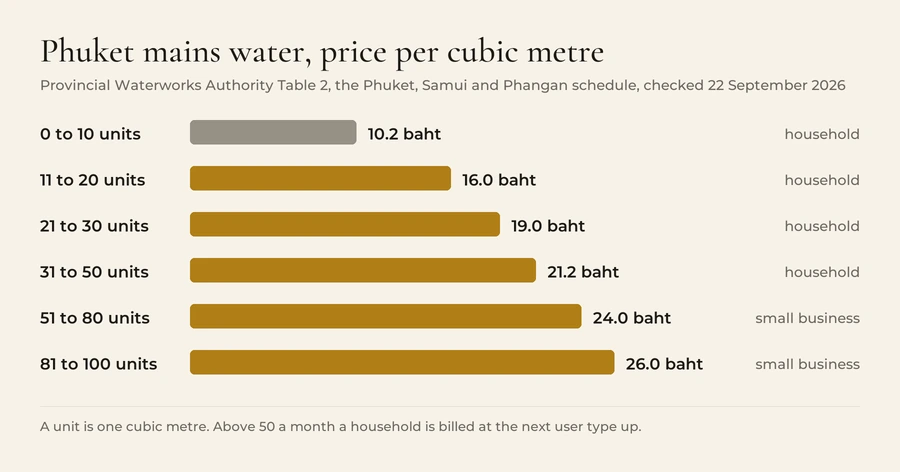
A household using the full 50 cubic metres pays ฿876 for the month, and the minimum charge is ฿50. The catch is the rule printed under the table: once a residential account passes 50 cubic metres in a month, the water above it is charged at the small-business rate, which in Phuket starts at ฿24.00 a cubic metre. A villa topping up a pool through the hot season and watering a garden gets there.
Two things to establish before signing. Whether the villa is on mains water at all — plenty of estates run a well, a tanker contract or an estate-owned supply, none of which is on the PWA schedule. And if the villa sits behind an estate meter rather than its own, what the estate adds on top.
4. The services with no published price
Electricity and water have tariffs you can look up. The rest of a villa's running costs do not, and we are not going to print an average for them. There is no published schedule for pool maintenance in Phuket, prices are agreed villa by villa, and a number we cannot source would be worth less to you than the blank.
What we can tell you is the list, because it is the same list every time, and each line has to be assigned to somebody in the lease:
- Pool service. Usually weekly or twice weekly, chemicals included or not. Ask which, and ask who calls the engineer when the pump fails.
- Garden. Cutting and clearing, and separately whether replanting is anybody's duty.
- Air-conditioner servicing. Filters and a gas check, typically a few times a year in this climate.
- Pest control. Termites in particular. A villa without a contract is a villa relying on the tenant to notice.
- Internet. An existing line in the landlord's name, a new line in yours, or nothing at all.
- Estate or common-area fee. On a managed estate, security, street lighting and shared landscaping are billed to the owner. Whether that is passed to you is a lease question, and it should be a figure, not a principle.
- Cleaning. A maid's room appears on 64 of our 1,856 rentals. A room is not a service.
Get each of those written into the lease with a name against it. A spoken arrangement about the pool service survives exactly as long as the person who made it, as we set out in our guide to the lease clauses that matter.
5. What the law gives you, and when it does not reach you
Thailand regulates residential letting as a contract-controlled business. The current instrument is the Notification of the Contract Committee on Residential Building Leasing as a Contract-Controlled Business, B.E. 2568, published in the Royal Gazette on 6 June 2025 and in force ninety days later, on 4 September 2025. It repealed the 2019 version.
Where it applies, its standard short-term lease bans a list of terms outright. Among them, a landlord may not:
- take advance rent and a deposit together amounting to more than three months' rent;
- charge electricity or water above the rate the supplier charges the landlord;
- change the rent or the service charges before the lease ends;
- keep the deposit where the tenant is not at fault;
- enter to inspect without notice, except in an emergency;
- charge an existing tenant a fee to renew;
- make the tenant liable for wear that comes from ordinary use.
Now the part that decides whether any of it helps you. The notification applies to a lessor letting three units or more, whether in one building or several combined. Most Phuket villa landlords are individuals with one house. If yours is, none of the list above binds them, and your tenancy runs on the hire-of-property sections of the Civil and Commercial Code plus whatever the contract says.
That is not a reason to give up on the terms. It is a reason to ask for them as terms. Utilities at the provider's rate against a photographed meter reading, a fixed rent for the fixed term, and a named owner for every service line are all drawn from the state's own model contract, and all far easier to agree the week before you sign than the week after you move in.
The eight questions to settle before signing
- Is electricity billed against the villa's own PEA meter, at PEA's rate, with the bill shown to you?
- Is water mains, well, tanker or estate supply, and who reads the meter?
- If the villa sits behind an estate meter, what does the estate add per unit?
- Pool service: whose contract, what frequency, chemicals in or out, and who pays when the pump fails?
- Garden: whose contract, and how often?
- Is there an estate or common-area fee, and is it charged to you? In figures.
- Internet: whose line, what speed, whose name on the account at handover?
- Meter photographs on the day you take the keys, signed by both sides and annexed to the lease.
None of these is unusual to ask, and a landlord who will not answer them in writing has told you something useful.
If you are working through a shortlist, our long-term rental listings carry the asking rent and the property's own details; the inclusions come from the lease, and we will get them in writing before you commit. Tell us what you are looking for and we will put the questions above to the owner before you see the house.