
A Phuket villa arrives with a story attached: who built it, who owns the land, what the view is worth, what it will let for. Due diligence is the stage of the purchase where you stop listening to the story and read the records instead. There are fewer of them than people expect, and every one of them exists before you pay anything.
This is the order in which it makes sense to take them, and the order in which a lawyer's report should come back to you. It is not legal advice and it does not replace that lawyer. It is written so that you know what the report ought to contain, and what a missing line in it means.
One caveat before the detail. The statutes below are quoted from unofficial English translations, and the Phuket environmental notification from our own reading of the Thai text in the Royal Gazette. Only the Thai texts have legal force, and the sources block names every one we relied on.
When it happens, and why the timing matters
Due diligence runs in the window between the reservation deposit and the sale and purchase agreement — typically two to four weeks of exclusivity, as we set out in every fee between offer and keys. Two things follow from that. The deposit agreement has to say what happens to the money if a check fails. And the checks have to be finished before anything larger is paid. A problem found after the agreement is signed is a negotiation. The same problem found before it is a reason to leave with your deposit.
Doing it properly is cheap against the asset. One Thai firm publishes a starting price of 30,000 baht plus VAT for a land-or-house due diligence, and lists the scope as title history, encumbrances, access, zoning and building-permit checks. With VAT that is 32,100 baht — about 0.14% of 22,250,000 baht, the median asking price across the 568 priced, available villas on our sale book on 15 September 2026. Expect more on a complicated title or a large estate.
1. The title: the Land Office register, not the seller's copy
A photocopy of a deed shows what the deed said on the day it was copied. The register shows what it says now. The first job is a search at the Land Office where the parcel is registered, and it should answer four questions.
- What kind of document is it? Thai land documents differ in how firmly the boundary is fixed and in what can be registered against them. Identify the type before anything else; we are giving the deed types an article of their own.
- Who is the registered owner? The name on the register must be the person, or the company, signing your contract — checked against an identity document or the company's registration, not a business card.
- What is registered against it? Mortgages, leases, usufructs, superficies and servitudes are all endorsed on the title. A mortgage is not in itself a reason to walk away. It is a reason to agree in writing how and when it is discharged at the Land Office, and out of which money.
- Where exactly is it, and how big? The Department of Lands' LandsMaps service plots registered parcels on satellite imagery, with the area and the official appraised value for each. Walk the boundary markers against that outline, then compare the area on the deed with the plot size you were quoted.
That last comparison matters because the quoted figure is marketing. On our own book, 559 of the 568 villas for sale state a plot area. That figure is what the listing says, not what the deed says — two of those listings give plots of under 80 square metres, which is a data-entry error rather than a villa. The deed records area in rai, ngan and square wah: one square wah is four square metres, and one rai is 400 square wah, or 1,600 square metres.
2. The seller: who they are, and who may sign
If the seller is an individual, the check is identity: passport or Thai ID against the register, and any power of attorney examined properly if someone else is signing on their behalf.
If the seller is a Thai company, the Department of Business Development's DBD DataWarehouse gives its registration status, its directors, its registered capital and the financial statements it has filed. Check that the company is active, that the people signing are its listed directors, and that it is not a foreigner's 51–49 vehicle whose exposure you would be inheriting. Why that structure is an offence for everyone who signs it is set out in how foreigners actually hold Phuket property.
3. Access: a plot that cannot reach the road is a problem you buy
Hillside plots in Phuket are often reached across somebody else's land. Ask how, and then ask how that right is recorded. There are three answers worth having.
- A registered servitude. Section 1387 of the Civil and Commercial Code allows one property to be burdened for the benefit of another, which is how a right of way is created. Check that it is actually endorsed on the neighbour's deed, not merely promised in a letter. Section 1399 extinguishes a servitude that goes unused for ten years.
- A statutory right of passage. Section 1349 lets the owner of land with no access to a public way pass over the surrounding land, and it expressly extends to land cut off by a steep slope. It is a genuine right. It also has to be claimed, the neighbour is owed compensation, and the route is chosen to do the neighbour the least damage — not to suit your driveway.
- A road inside a licensed estate. That is the next check.
A track the neighbour "has always let people use" is none of these.
4. The estate: is it a licensed land development?
Many villas are one plot among many. On our book, 167 of the 568 villas for sale — 29.4% — are listed inside a named project, and that is where this check most often bites. The Land Development Act B.E. 2543 decides what their buyers are protected by.
Section 4 defines land development as the sale of land divided into ten or more sub-parcels, and it deliberately catches the developer who splits a parcel into fewer than ten and divides again within three years to reach ten. Section 21 prohibits carrying it on without a licence from the Land Development Board. Section 59 sets the penalty at up to two years' imprisonment and a fine of 40,000 to 100,000 baht.
The penalty is the developer's. The loss, if there is one, is the buyer's, because the protections a buyer relies on are written for licensed projects. Under Section 43, the roads, gardens and similar utilities in a licensed development become subject to a servitude for the benefit of the plots, and the developer must maintain them, backed by a bank guarantee. Section 44 releases the developer from that duty only once the buyers have formed a housing development juristic person to take the utilities over, or by one of two other routes the Act sets out.
The Department of Lands publishes a search of licensed land developments and condominiums by province and land office. Ask the developer for the licence, and find the project on it. On a large estate there is one more document: in Phuket, a residential land development of 100 to 499 plots, or of 19 to 100 rai, must also have an initial environmental examination report under the 2024 provincial notification.
5. The house: was it permitted, and is it what was permitted?
Section 21 of the Building Control Act B.E. 2522 requires anyone who constructs, modifies or relocates a building either to obtain a permit from the local competent officer or to notify that officer under Section 39 bis. Section 4 names who that officer is — outside Bangkok and Pattaya, the mayor of the municipality or the chairman of the provincial or subdistrict administrative organisation.
Ask for the permit and the approved drawings, and hold them up against the house: floors, footprint, height, the pool, the room built over the carport. Then understand what a gap means.
- Section 40 lets the local officer order unlawful work stopped and the building closed to use.
- Section 41 allows a building that can be put right to be regularised, on an order giving at least thirty days.
- Section 42 allows an order to demolish, in whole or in part, where it cannot be put right or the owner has not complied.
- Section 65 punishes building without a permit with up to three months' imprisonment, a fine of up to 60,000 baht, or both — plus a daily fine of up to 10,000 baht until it is put right.
The orders in Sections 40 to 42 are addressed to the owner or occupier of the building. After transfer, that is you. A missing permit on a finished villa is a price conversation, a sum held back until it is regularised, or a reason to leave — never a line to note and move past.
6. The land itself: the Phuket environmental notification
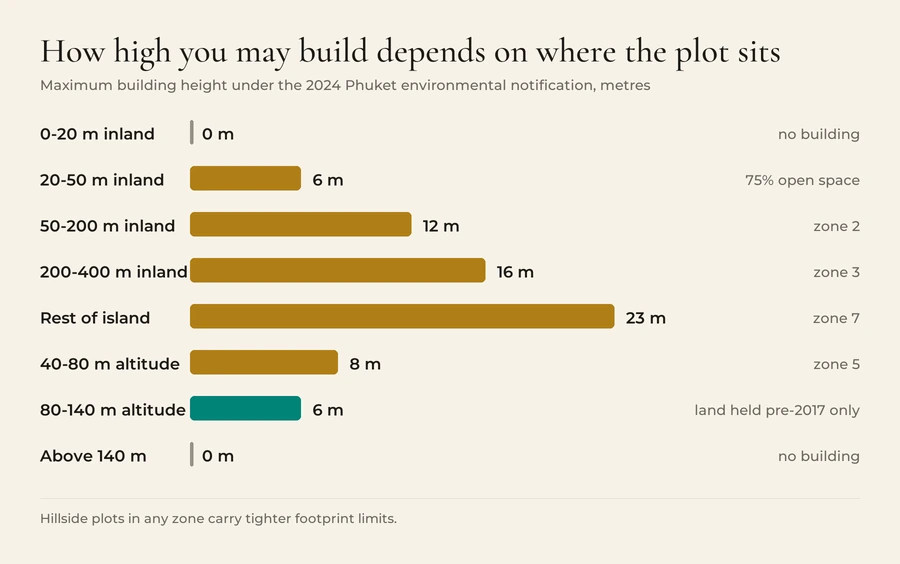
This is the check most buyers from abroad have never heard of, and on a hillside plot it can decide whether the land is worth what is being asked. The Ministry of Natural Resources and Environment's notification designating environmental protection areas in Phuket was published in the Royal Gazette on 13 December 2024, took effect the following day, and runs for five years. It divides the province into eight areas, by distance from the shore and by height above mean sea level, and sets what may be built in each.
| Where the plot is | Height | Conditions |
|---|---|---|
| Within 20 m of the shoreline | None | Minimum setback |
| 20–50 m inland (area 1) | 6 m | At least 75% of the plot left open |
| 50–200 m inland (area 2) | 12 m | Permeable ground at least 50% of the open space, and half of that green |
| 200–400 m inland (area 3) | 16 m | The same ratios; where building-control or town-planning law applies, its height rule governs |
| Rest of the island (area 7) | 23 m | Where building-control or town-planning law applies, its rules govern |
| 40–80 m above sea level (area 5) | 8 m | Permeable ground at least 50% of the open space, and half of that green |
| 80–140 m above sea level (area 6) | None, with one exception | Land held before the 2017 notification: one detached house, 6 m, footprint up to 90 sq m, 70% open |
| Above 140 m (area 6) | None | The exception does not apply |
Three things in that table decide real transactions.
Height above sea level beats distance from the shore. Areas 1 to 3 are defined to exclude areas 5 and 6. A plot a few hundred metres from the beach but ninety metres up the hill is governed by the altitude rule, not the coastal one.
Above 80 metres, the date the land was acquired matters. Building in area 6 is prohibited, with exceptions for state, utility and conservation uses and one for private land: land owned or lawfully possessed before the 2017 notification came into force may carry a single detached house no higher than six metres, with a footprint of no more than 90 square metres and at least 70% of the plot left open. The notification states in terms that this exception does not reach land above 140 metres. Read the Gazette text rather than a summary of it — it is the text the permit officer applies.
Hillside plots carry a footprint cap wherever they sit. On land the notification treats as hillside — by reference to the standards of the Department of Public Works and Town & Country Planning — areas 1, 5 and 6 allow only a detached house of up to six metres, and areas 2, 3, 4 and 7 up to twelve. On a plot of 100 square wah or more, the footprint may not exceed 90 square metres, with at least 70% permeable ground. On a smaller plot the limits are 70 square metres and 50%.
| Stated plot area | Villas | Share |
|---|---|---|
| Under 400 sq m | 266 | 47.6% |
| 400–799 sq m | 207 | 37.0% |
| 800–1,599 sq m | 54 | 9.7% |
| 1,600 sq m and up | 32 | 5.7% |
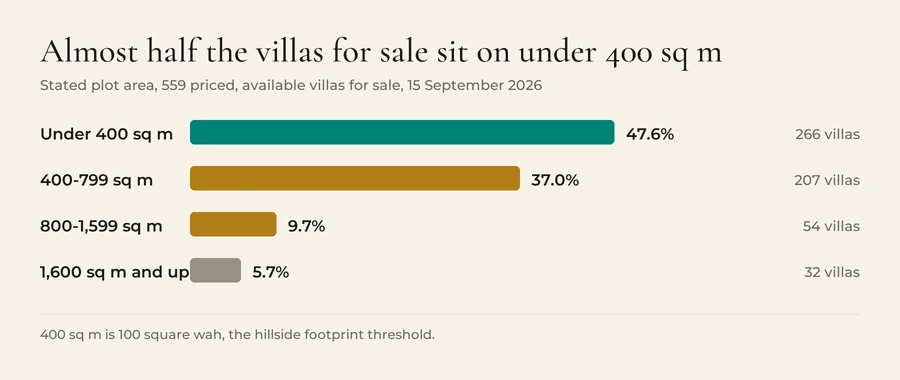
The 100 square wah line is 400 square metres, and it runs straight through the middle of the market: 266 of the 559 villas on our book that state a plot size fall below it. That does not make them hillside plots — our catalogue does not record slope. It means that on any of them that is, the smaller cap is the one that applies, and the house the plot can lawfully carry is correspondingly modest.
Existing buildings are protected. Clause 19 exempts buildings already standing when the notification took effect, while forbidding their alteration, or a change of use, into anything it prohibits. Clause 20 lets permitted construction already under way finish under the old rules. For a finished villa, then, the question is not whether it could be built today. It is whether it was permitted when it was built — check five — and whether the extension you have in mind is still allowed, which is this one.
What each failed check puts at stake
| Check | If it fails | Authority |
|---|---|---|
| Title | The deed does not say what you were told it says | Land Office register |
| Seller | The person signing is not the person who can transfer | Land Office register; DBD |
| Access | No recorded right to reach the plot | CCC ss.1349, 1387 |
| Estate licence | The utility servitude and maintenance guarantee are written for licensed projects | Land Development Act ss.21, 43, 44 |
| Building permit | Stop, regularisation or demolition orders addressed to the owner | Building Control Act ss.40–42 |
| Environmental area | A plot that cannot carry the house you priced | MNRE Phuket notification, 2024 |
Five ways this goes wrong
- A deposit with no refund condition. Due diligence is only worth doing if a failed check lets you leave. Put that in the reservation agreement before the money moves.
- A photocopy accepted as a search. The register is the record. A copy is a claim about the register.
- The listing's plot size taken as fact. Ours included. The deed decides the area, and the area decides the footprint.
- "The permit is being arranged." Section 21 concerns the building that exists, and the orders that follow concern its owner.
- Hillside land priced as buildable before anyone has checked its height above sea level. Above 80 metres, the answer turns on when the land was acquired; above 140, there is no answer.
The checklist
- A reservation agreement that returns the deposit if due diligence fails.
- A Land Office search: document type, registered owner, everything endorsed on the title.
- The parcel found on LandsMaps, the boundary markers walked, and the deed area matched to the plot you were quoted.
- The seller's identity checked; for a company, its DBD status and directors.
- Access by a servitude endorsed on the neighbour's deed, or by a licensed estate road.
- For a plot in an estate of ten or more, the land development licence, found on the Department of Lands search.
- The building permit or Section 39 bis notification, with approved drawings that match the house.
- Height above sea level, hillside status and notification area, and the footprint that follows from them.
- All of it in a written report from your own lawyer, before the sale and purchase agreement is signed.
None of these checks is exotic, and none depends on trusting anybody's account of the property, ours included. If you are looking at a particular villa and want to know which of them will bite — the estate, the permit, the height on the hill — tell us what you are considering, or contact the desk directly. If it passes, the next question is structure, and the 30-year leasehold, honestly is the place to start.