
Three routes let a foreigner stay in Thailand for years rather than months on a single visa: the Destination Thailand Visa (DTV), the Long-Term Resident visa (LTR) and the Thailand Privilege membership, still widely called Elite. They are not versions of one thing. The DTV is a consular visa with a bank-balance test, the LTR is a Board of Investment programme with income and asset tests, and Thailand Privilege is a paid membership. This guide sets the three side by side using each scheme's own published pages, read on 15 October 2026.
ZEN Real Property publishes this as a guide, not as legal advice, and the Immigration Bureau and the issuing embassy decide every application. ZEN also sells and lets villas in Phuket, which touches two of the routes below, and we say where.
The three routes at a glance
| DTV | LTR | Thailand Privilege | |
|---|---|---|---|
| Issued through | Thai embassies and consulates, applied for on the e-Visa portal | Board of Investment endorsement, then the visa at the One Stop Service Center or an embassy | Thailand Privilege Card Co., with approval by the Department of Consular Affairs |
| Length | 5 years' validity, 180 days per entry | 5 years, extendable by 5 more if the conditions are still met | 5, 10, 15 or 20+ years, by tier |
| What you must show | At least 500,000 baht in the bank, plus proof of remote work or of a qualifying activity | Average income of USD 80,000 a year, or USD 1 million in assets, by category, plus insurance or a deposit | The application page asks for a passport, a photo and a form |
| Cost | Set per mission: 350 euro at Budapest, 350 Swiss francs at Bern | 50,000 baht per person for ten years | 650,000 to 5,000,000 baht, by tier |
| Work in Thailand | No Thai work permit; no work for Thai companies or clients | Digital work permit available, at 3,000 baht a year | The page we read does not address it |
The DTV: a bank balance, not an income test
The DTV allows up to 180 days per entry across five years of validity. The Royal Thai Embassy in Budapest describes it as a special kind of tourist visa, which is why holders are barred from a Thai work permit and from working for Thai companies or performing freelance work for Thai clients. The Swiss embassy adds that a stay can be extended for another 180 days, after which the holder must leave and re-enter within the visa's validity. Three purposes qualify: remote work, a Thai soft-power activity such as Muay Thai, cookery training or medical treatment, and being the spouse or child under 20 of a holder.
The documents depend on which mission you apply to, and that is the first thing to understand about it. A Thai embassy checklist hosted by the Ministry, apparently Kuala Lumpur's since it quotes ringgit equivalents and was created in August 2024, asks for a three-month bank statement ending at no less than 500,000 baht, six months of salary slips, proof of six months' prolonged residence in Thailand such as a lease, and an employment contract or company registration authenticated by the embassy of the company's country. Budapest, on a page last updated 18 August 2026, asks for a six-month bank statement and says crypto and investment statements are not accepted. Phnom Penh's page, last updated in July 2024, lists the 500,000 baht as evidence that can include payslips or a sponsor. Same visa, three lists.
What changed for DTV applicants on 31 August 2026
Several law firms and visa agencies report that applications made on or after 31 August 2026 are handled differently. According to those reports, an applicant must apply at the Thai mission covering their nationality or permanent residence rather than at any convenient embassy, and must supply a police clearance certificate, issued within six months at the London mission, with an English translation if needed. Applications whose fee was paid in full before 31 August are reported to be assessed under the old rules. One report says the London mission lets dependants under 16 rely on the main holder's certificate.
We could not reach the Ministry of Foreign Affairs' own notice. The e-Visa site returned only a shell page, the London and Vientiane DTV pages load their text client-side, and Budapest's page, last updated 18 August 2026, still lists proof of current location rather than permanent residence. So this is reported, not confirmed. Before you pay a fee, get the current checklist from the mission that will process your application. Our earlier DTV guide covers the visa's launch terms; for fees and documents use the embassy pages cited below, which are newer.
The six-month residence proof is where Phuket comes in: that checklist names a lease as an example. Our guide to the clauses that matter in a long-term villa lease covers what to check before you sign one, and the long-term rental listings show what is on our book.
The LTR: four categories, each with its own test
The Board of Investment runs the LTR through four categories, and the criteria differ for each. Every condition must be maintained for the whole length of the visa, including balances, employment and insurance.
| Category | Income or assets the BOI publishes | Other conditions |
|---|---|---|
| Wealthy Global Citizen | At least USD 1 million in assets, with at least USD 500,000 invested in Thailand in the applicant's own name | No income test is listed. The investment must be held before applying |
| Wealthy Pensioner | Age 50 or over, with passive income of USD 80,000 a year; from USD 40,000 up to that figure, an additional Thai investment of USD 250,000 | Salary and earned income do not count |
| Work-from-Thailand Professional | Average income of USD 80,000 a year over the past two years; USD 40,000 to 80,000 with a master's degree or higher | An employment contract with a listed company, or a private company with at least 3 years of operation and USD 50 million of combined revenue over 3 years |
| Highly-Skilled Professional | The same USD 80,000 test, or USD 40,000 to 80,000 with a master's degree or higher in science and technology | A contract with a company in a BOI targeted industry, or proof of expertise in a field the BOI specifies |
Every category also needs one of three things: health insurance of at least USD 50,000, current Thai social security benefits, or at least USD 100,000 held in the applicant's own bank account for at least 12 months. Our healthcare guide covers how that requirement sits with the rest of Thailand's insurance rules.
The BOI lists the benefits as: a five-year stay extendable by five, an exemption from the four-Thais-to-one-foreigner staffing ratio, fast-track airport service, one-year rather than 90-day reporting, multiple re-entry, a digital work permit, a 17% personal income tax rate for highly-skilled professionals and an exemption on overseas income. It publishes its own timeline: about three working days to a first document request, then 17 working days of consideration by government agencies, which it says may run longer, and the endorsement result stays valid for 60 days, within which the visa must be collected. The processing fee is 50,000 baht per person for ten years, and the BOI says embassies usually charge more depending on the exchange rate and local additions. The work permit is 3,000 baht a year.
One line concerns property. The Wealthy Global Citizen category lets the USD 500,000 Thai investment be Thai government bonds with at least five years remaining, direct investment in a Thai company, or investment in Thai property, in the applicant's own name. How a foreigner can hold a house or land is a separate and restrictive subject, covered in our guide on foreign ownership in Phuket, and the BOI's list does not say which holdings it accepts. We sell villas, so weigh this paragraph with that in mind and ask the BOI, not us, whether a particular holding qualifies.
Thailand Privilege: a fee instead of a test
The programme's comparison page lists five tiers. Bronze is 650,000 baht for five years with no points; Gold is 900,000 baht for five years with 20 lifestyle points a year; Platinum is 1,500,000 baht for ten years with 35; Diamond is 2,500,000 baht for 15 years with 55; and Reserve is 5,000,000 baht for 20 years or more with 120. Applicants submit a passport with at least a year left, a photo and a form; the Department of Consular Affairs reviews it, with approval promised within two months, and the visa can be affixed on arrival at the Bangkok, Phuket or Chiang Mai airports.
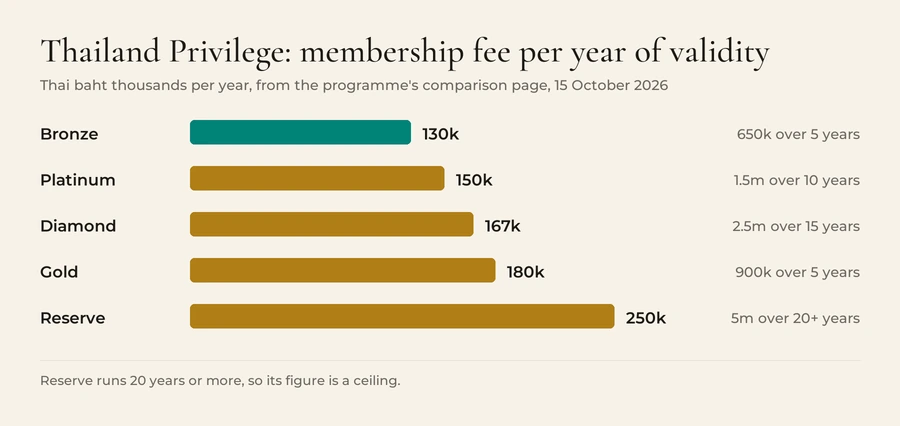
| Tier | Fee | Validity | Points a year |
|---|---|---|---|
| Bronze | 650,000 baht | 5 years | None |
| Gold | 900,000 baht | 5 years | 20 |
| Platinum | 1,500,000 baht | 10 years | 35 |
| Diamond | 2,500,000 baht | 15 years | 55 |
| Reserve | 5,000,000 baht | 20+ years | 120 |
Bronze is the one to check. The official page still listed it on 15 October 2026, but agent websites have reported three different closing dates for it in 2026: 31 March, 30 September and, most recently, 31 December. We could not find a notice on the programme's own site, so treat Bronze as a window that may close and confirm the date directly.
Which route fits which situation
- Working remotely for an employer abroad, on a modest income: the DTV and Thailand Privilege are the two without an income test, and the DTV's fee is set per mission rather than in the hundreds of thousands of baht. The LTR's lowest published income band is USD 40,000 a year, and only with a master's degree.
- Wanting to be employed by a Thai company: the DTV rules this out. The LTR's work permit and the Highly-Skilled category exist for it.
- Retired, with a pension: the LTR Wealthy Pensioner category needs USD 80,000 a year of passive income, or USD 40,000 plus a Thai investment of USD 250,000. Thailand Privilege lists no income test on its application page.
- Wanting years of cover in a single payment: Thailand Privilege, at the price in the table.
What this guide did not check
We read the Immigration Bureau's rules only as embassies and the BOI restate them, not on the Bureau's own site. We did not verify the 31 August change at the Ministry. We did not compare tax residence, the 90-day or annual reporting rules, or what each visa means for opening a Thai bank account or buying property. Third-party prices for agent services are left out because we could not stand any of them up against a published page. Thresholds are quoted in the currency each scheme uses, with no conversion, because the exchange rate moves under them.
If you are weighing a move and want to see what rents and sells where you would live, talk to the ZEN team. For the visa itself, the issuing embassy and the BOI are the authorities.