
A Phuket villa deposit is usually two months' rent, which on a three-bedroom house in Bang Tao is ฿300,000. Whether it comes back, when, and what can be taken out of it depends on a few lines in a contract and on something most tenants never check: whether the landlord is covered by a consumer-protection notification that fixes the answers by law.
This guide sets out what the Civil and Commercial Code says (very little), what the 2025 notification and the state's model lease require of covered landlords, and what a tenant can do to be ready for the day the keys go back. It is general information from public sources, not legal advice. The clauses worth negotiating before you sign are covered in our lease guide; this one is about the other end of the tenancy.
Which rules apply to your landlord
The Code's hire-of-property sections (537 to 571) contain no rule on deposits. Two sections matter indirectly. Section 561: if no written description of the property's condition was made and signed by both sides, the tenant is presumed to have received it in good repair and must return it that way, unless the tenant can prove otherwise. Section 562: the tenant is liable for damage caused by their own fault or that of people living with them, but not for damage resulting from proper use.
On top of that sits the Contract Committee's notification making residential leasing a contract-controlled business, signed on 30 May 2025 and published in the Royal Gazette on 6 June 2025 (volume 142, special part 211 ง, pages 80 to 84). It takes effect ninety days after publication, and leases signed before then run on their old terms. It reaches an operator who lets residential premises for a fee, three units or more, in one building or across several. "Building" includes a house. The tenant must be an individual renting to live in the property. That settles the unit threshold our earlier lease guide left open: the Gazette text says three.
The consequence is simple. A company or individual letting a portfolio of villas is a covered operator. A private owner letting their own single villa is not, and for that tenancy the contract is the whole story. Ask the landlord, in writing, which one they are.
What a covered landlord may not write into the lease
The notification lists clauses an operator must not use, and the state publishes a model short-term lease (form ก, for terms up to three years) that operators must follow. The ones that bear on a deposit:
- A cap. No clause letting the operator collect deposit and advance rent that together exceed three months' rent. A parallel limit in the long-term form applies where rent is quoted by the year.
- No forfeiture without fault. No clause letting the operator keep the deposit or advance rent when the tenant is not at fault.
- No charging for ordinary use. No clause making the tenant liable for damage from normal use, for normal deterioration, or for damage that is not the tenant's fault.
- No unannounced entry to inspect, except in an emergency; no utilities billed above the provider's own rate; no locking the tenant out or seizing belongings before a lawful termination.
The notification also defines the two sums. The deposit is money held against damage the tenant causes to the property supplied for their use and against outstanding charges that are not rent. Advance rent is a separate sum, kept as security for rent and either returned at the end or applied to the last month. Many private contracts blur the two. If yours does, ask which is which.
The usual Phuket shape, two months' deposit plus one month in advance, lands exactly on the three-month ceiling. Here is what that is on a three-bedroom villa, at asking rents in our catalogue on 13 October 2026:
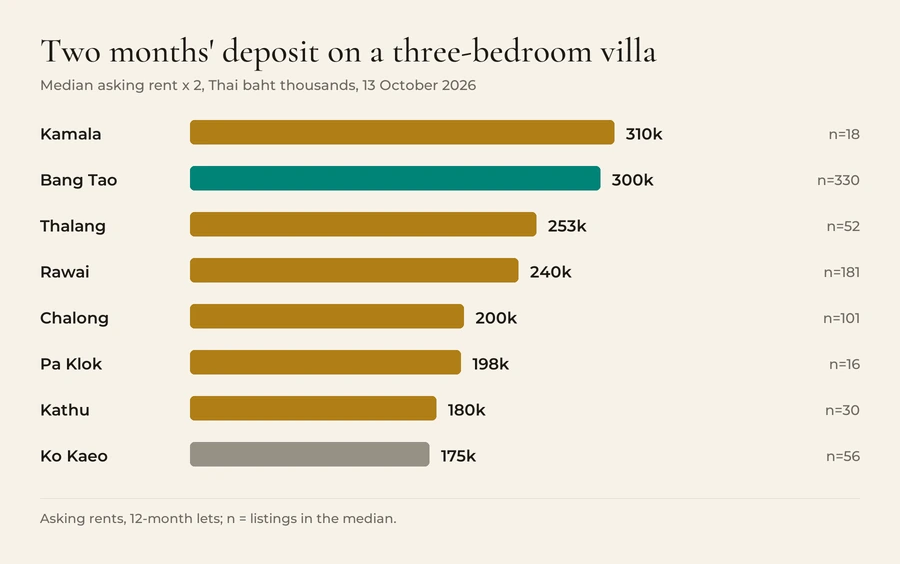
| District | Listings | Median rent a month | Two months' deposit | Plus one month ahead |
|---|---|---|---|---|
| Kamala | 18 | ฿155,000 | ฿310,000 | ฿465,000 |
| Bang Tao | 330 | ฿150,000 | ฿300,000 | ฿450,000 |
| Thalang | 52 | ฿126,500 | ฿253,000 | ฿379,500 |
| Rawai | 181 | ฿120,000 | ฿240,000 | ฿360,000 |
| Chalong | 101 | ฿100,000 | ฿200,000 | ฿300,000 |
| Pa Klok | 16 | ฿99,000 | ฿198,000 | ฿297,000 |
| Kathu | 30 | ฿90,000 | ฿180,000 | ฿270,000 |
| Ko Kaeo | 56 | ฿87,500 | ฿175,000 | ฿262,500 |
These are asking rents, not signed ones, and the deposit shown is the common shape rather than a figure any listing publishes. Kamala, Pa Klok and Kathu rest on fewer than thirty listings each; treat them as indicative.
At move-in: build the record
Section 561 puts the burden on you if nothing is signed. The state's model lease therefore requires the operator to attach a condition record to the lease and give the tenant a copy. Whoever the landlord is, do the same: photograph every room, the pool, the appliances and the garden on the day you receive the keys, list every existing mark, and have both sides sign and date it. Keep the originals with their timestamps, and email yourself the set.
At move-out: the clock
For a covered landlord, the model short-term lease sets this sequence:
| Situation | What the model lease requires |
|---|---|
| Lease ends | The deposit is returned immediately, unless the operator wants to inspect for damage |
| No damage | Returned within seven days of the lease ending and possession being regained, with the operator bearing the cost of sending it by the method the tenant gives |
| Damage | The operator may deduct what it costs to put the damage right; the balance follows within fourteen days |
| Normal wear | No deduction for normal use, normal deterioration, anything that is not the tenant's fault, or force majeure |
We read the short-term form, which is the one a twelve-month villa lease falls under; the long-term form was not read for this piece. A private landlord has no such deadline unless the contract gives one, which is why the return date belongs in the lease.
One more clock runs the other way. Section 563 bars any action by the landlord against the tenant arising from the lease once six months have passed since the property was returned. It protects the tenant from a late damage claim; it says nothing about the tenant's own claim for the deposit.
If it does not come back
- Ask in writing, by email and by the messaging app the lease names, giving the end date, the amount, your bank details and a deadline. Quote the lease clause, and the model lease if the landlord is covered.
- Ask for the deduction itemised with invoices or quotes, set against your move-in record.
- Complain to the Office of the Consumer Protection Board if the landlord is a covered operator: hotline 1166, or the online complaint system at complaint.ocpb.go.th.
- Court. The Consumer Case Procedure Act of 2008 lets a consumer file orally with a case officer, and waives court fees for consumer plaintiffs, with restrictions; that description comes from a 2008 law-firm note, so confirm it is still how the court works. For a private landlord the claim is an ordinary civil one, and a Thai lawyer should look at it.
On time limits, we did not find a provision giving a tenant a short deadline to claim a deposit back. The Code's general period where none is fixed is ten years (section 193/30), but that is a catch-all and not advice to wait. Do not leave it.
Checklist
- Ask whether the landlord lets three or more units. Get the answer in writing.
- Keep deposit and advance rent as two separate lines in the lease, each in figures and words.
- Annex a signed, photographed condition record.
- Write the return deadline and the bank account into the lease.
- List what may be deducted and exclude normal wear.
- Photograph and video the villa on move-out, and ask the landlord to inspect with you present.
If you are choosing a villa, our long-term rental listings carry the district and asking rent on every property, and what a villa rental includes sets out what the rent covers, which decides what a damage claim can reach.