
Most villa owners who ask about holiday letting are really asking one question: can I put the house on a booking site for a week at a time? Under Thai law the answer turns on the Hotel Act B.E. 2547, and on one ministerial regulation from 2023 that most guides describe loosely. This piece sets out what the texts say, what Phuket has enforced this year, and what Parliament has in front of it.
It is built from the Act itself (the Council of State's unofficial English translation, hosted by the Department of Provincial Administration), the 2023 regulation as published in the Royal Gazette, the Immigration Bureau's own page on residence notification, and Thai press reports of 2026 inspections in Phuket, all read on 29 October 2026. The Thai texts are the only ones with legal force, and our translations of them are unofficial. It covers villas and houses, not condominiums. It describes the rules, not a licensing service.
The short version
- Paid short stays are a hotel business. Section 4 of the Act defines a hotel as a place set up as a business to provide temporary accommodation for payment. Section 15 says nobody may run one without a licence from the registrar.
- Monthly lets are outside it. The same definition excludes accommodation charged monthly or longer.
- A small house can be taken outside it, but not automatically. Since 2023, premises with no more than eight rooms and thirty guests are not a hotel, once the owner has notified the registrar, an official has inspected, and a receipt has been issued.
- The penalty for running a hotel without a licence is up to one year in prison, a fine of up to ฿20,000, or both, plus up to ฿10,000 for every day the breach continues (Section 59).
- Two changes are pending and neither is law. A Hotel Act amendment passed its first reading in July 2026, and the government put forward a replacement Accommodation Establishment Act in September.
What the Act actually says
Section 4 defines a hotel as accommodation "established for business purposes of providing temporary accommodation service for travelers or any other person in exchange for compensation". It then excludes three things: state and charitable lodging run without profit, accommodation "for monthly paid service charge or upward only", and anything else a ministerial regulation excludes.
Nothing in the definition depends on size. A single villa let by the night to tourists fits it as well as a resort does. Section 15 then requires a licence from the registrar, and Section 16 sets the applicant's qualifications, including a domicile or residence in Thailand.
Two practical points follow. First, the Act does not mention thirty days. The exclusion turns on the rent being charged by the month or longer, which is why the common "thirty-day rule" is a paraphrase rather than the text. A monthly lease with monthly rent is the safe side of the line; a thirty-night booking priced by the night is not obviously the same thing. Second, a full hotel licence is hard to get for a house. The ministerial regulation on hotel categories, as amended in 2023, requires a building used as a hotel, in an area where the Building Control Act applies, to have permission under that Act to be used as a hotel. A house is not built or permitted as one.
The small-premises route: eight rooms, thirty guests, a receipt
The Ministerial Regulation on Types and Criteria of Hotel Business (No. 2) B.E. 2566 was published in the Royal Gazette on 30 August 2023 and came into force sixty days later. Its clause 2 rewrites the exclusion. Read from the Gazette, it says:
- Premises with no more than eight rooms in total, in one building or several, and room for no more than thirty guests, which provide temporary accommodation for payment, are not a hotel, but only where an official has inspected them and issued a receipt of notification.
- The owner notifies the registrar in the form the Minister sets. An official inspects, and if the premises meet the criteria the receipt is issued within forty days of notification.
- Notification and receipt are electronic. Where that is not possible, outside Bangkok, it is done at the district administration office (ที่ทำการปกครองอำเภอ) where the premises stand.
- The receipt is valid for five years from the date of notification. An owner who stops must tell the registrar.
The regulation's own explanatory note says the previous ceiling was four rooms, and that the change was meant for small places run to earn supplementary income. For a villa owner, the point is the order of events: the exclusion comes from the receipt, not from the house being small. A five-bedroom villa let to tourists before the receipt is issued is, on the face of the text, an unlicensed hotel.
Most Phuket villas are well inside the ceiling. On 29 October 2026 our catalogue held 1,704 villas and houses to rent with a published price, and 1,700 of them have eight bedrooms or fewer. A bedroom is not necessarily what the regulation means by a room, and the thirty-guest limit is a separate test, so treat that only as a sense of scale.
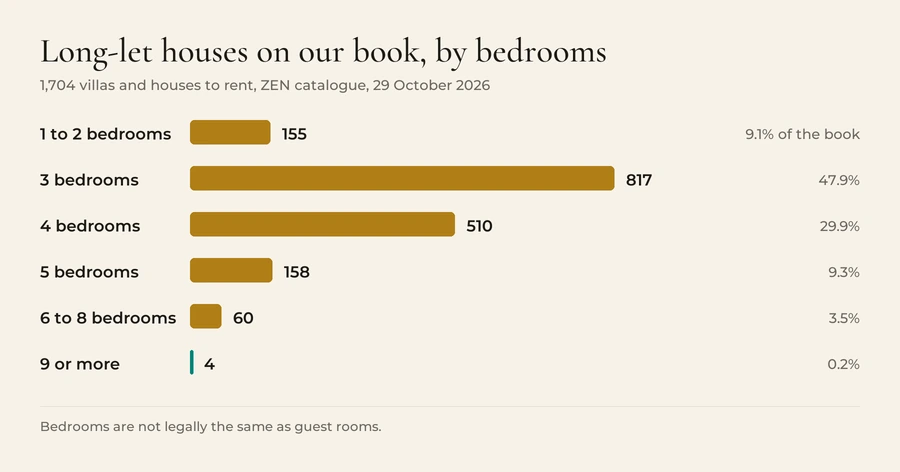
| Bedrooms | Listings | Share |
|---|---|---|
| 1 to 2 | 155 | 9.1% |
| 3 | 817 | 47.9% |
| 4 | 510 | 29.9% |
| 5 | 158 | 9.3% |
| 6 to 8 | 60 | 3.5% |
| 9 or more | 4 | 0.2% |
What the regulation does not settle is worth stating too. It sets no qualification for the person who notifies, and it does not address whether a foreign owner may run an accommodation business personally, which is a Foreign Business Act question. Estate and village rules are a third, separate layer: our Laguna review found the developer's owner page requiring lets of under six months there to go through its own operator. Ask a lawyer about the first and the estate about the second before counting on holiday income.
The duty that applies either way: TM30
Separately from the Hotel Act, Section 38 of the Immigration Act B.E. 2522 requires the head of the house, the owner or the occupier of a dwelling, or a hotel manager, who takes in a foreigner on temporary permission to stay, to notify immigration within twenty-four hours of the foreigner's arrival. The Immigration Bureau's own page says the owners of rental houses use form TM30 and lists three channels: in person, by registered post, or online. It applies to a long-let tenant as much as to a holiday guest, and it applies whether or not the house holds any hotel paperwork.
What Phuket has enforced in 2026
The published cases this year, in the reports we read:
- 24 February. Daily News reported a raid on a 219-room hotel on Patong beach that had traded for about three months. An official booked a room at ฿5,000 a night; no hotel licence or building permit could be shown, the manager was detained, and the charge cited Sections 4, 15, 48 and 59 of the Hotel Act. The same report gave the provincial registrar's figure of 988 licensed hotels in Phuket with 72,815 rooms.
- 11 July. A deputy interior minister led an inspection that found two hotels with neither an operating licence nor a building permit, with one flagged for possible nominee shareholding.
- 23 July. The province reported three establishments in Thalang and Mueang Phuket operating as hotels without a licence, all with foreign co-shareholders, and complaints filed with the police.
- 29 July. The governor led action against buildings letting rooms by the day, including 17 rooms in Kamala, and opened a clinic for unlicensed operators to regularise before enforcement.
Every case we found was a multi-room operation or a company, and several were tied to nominee investigations. We found no report this year of a private owner prosecuted over one villa. That is a description of the reporting, not a safe harbour: Section 59 does not scale with size, and booking a room as a guest is exactly how the February case was made. Some property websites print inspection totals for Phuket that we could not trace to any official statement, so they are not repeated here.
What may change, and when
On 8 July 2026 the House of Representatives accepted in principle a cabinet bill amending the Hotel Act and a second bill from a Bhumjaithai MP, and sent them to a 25-member special committee. The account we read described the cabinet's bill as a small amendment and did not set out what it changes for short stays.
On 29 September 2026 the government's deputy spokesperson presented a draft Accommodation Establishment Act of 98 sections, put forward for approval in principle, which would replace the hotel law. As reported, it sorts premises into three tiers: notification for up to eight rooms and thirty guests, registration for nine to forty rooms or thirty-one to 150 guests, and a licence above that. It names sharing-economy rentals of rooms, condominiums and houses among the kinds of accommodation it brings in, and would require guest registers to be sent electronically every twenty-four hours. The Council of State had held two public hearings on it in 2025.
Neither text is law today. Until one is enacted and published in the Royal Gazette, the 2004 Act and the 2023 regulation are the rules.
What this means for an owner
- Letting by the month or longer, with monthly rent, keeps the house outside the Hotel Act's definition. File TM30 for foreign tenants.
- Letting by the night or the week needs either the small-premises receipt or a hotel licence first. Notify, wait for the inspection, and keep the receipt.
- Check the estate's own rules and the ownership question separately. Neither is answered by the Hotel Act.
- Do not price a purchase on holiday income you cannot yet lawfully earn. Our yield analysis uses long-let rents for that reason, and our piece on branded residences explains why hotel-run rental pools exist at all.
Where ZEN stands
We should say plainly that we do not arrange holiday lets. On 29 October 2026, 1,684 of the 1,704 villas and houses to rent on our book carried a twelve-month minimum, and none had a minimum under six months. That is the market this desk knows, and it is why this piece describes the law rather than selling a route around it. If you are weighing a purchase and want to talk through what long-let income looks like for a particular house, get in touch with our desk, or browse villas for long-term rent.