

There are five charges on a Phuket property transfer. Two of them the law does not allocate to anybody, and the three it does allocate all sit on the seller. That matters to a buyer as well, because a seller facing a bill they had not budgeted for is a seller who stalls at the counter.
We have published the buyer's side of this in full: every line between offer and keys, and why the lease route costs about 1.3% of the price. This is the other half — the seller's bill, the annual tax that follows it, and who actually hands over what on the day. The thing to know first is that the seller's bill is not a rate. It is a function of how long they have held the property, and it peaks in year five.
The five charges, and who the law puts them on
| Charge | Rate | Charged on | Paid by |
|---|---|---|---|
| Transfer registration fee | 2% | Appraised value | Not allocated — a contract term |
| Specific business tax | 3.3% | Higher of appraised value or sale price | Seller |
| Stamp duty on a sale | 0.5% | Higher of appraised value or sale price | Seller |
| Withholding income tax | Sliding | Appraised value | Seller |
| Lease registration fee | 1% | Rent for the whole term | Not allocated — a contract term |
Two of those five are the ones people argue about at the counter, because the law does not say who pays them. The transfer fee and the lease registration fee are set by the Land Department and that is all: the split is whatever your sale and purchase agreement says, and if the agreement is silent you will be negotiating it with a cashier's cheque already drawn.
The three that are allocated all sit on the seller. Specific business tax and stamp duty are alternatives, never both — the Revenue Department states plainly that a seller who pays specific business tax has no stamp duty liability at all. And the withholding tax is not a separate tax but a prepayment against the seller's own income tax, collected at the window.
The five-year cliff
Specific business tax applies to a sale of immovable property made within five years of acquisition. That rule comes from Royal Decree No. 342, which lists the cases treated as a sale "for a commercial or profitable purpose", and the five-year test is the catch-all at the end of the list.
The decree carves out seven exceptions. Three of them come up in practice:
- Inheritance. A property acquired by inheritance is outside the rule however soon it is sold.
- A principal residence. A seller whose name has been in the house registration for the property for at least one year from the date of acquisition is exempt. Where the land and the building were acquired at different times, the five years runs from the later of the two.
- A gift to a legitimate child. Transfers without consideration to the seller's own legitimate children — adopted children are expressly excluded.
Expropriation, inheritance to legal heirs, and transfers or exchanges with a government body without other consideration make up the rest. Outside those, a sale inside five years carries 3.3% and a sale after it carries 0.5% — on 10 million baht, the difference between 330,000 and 50,000.
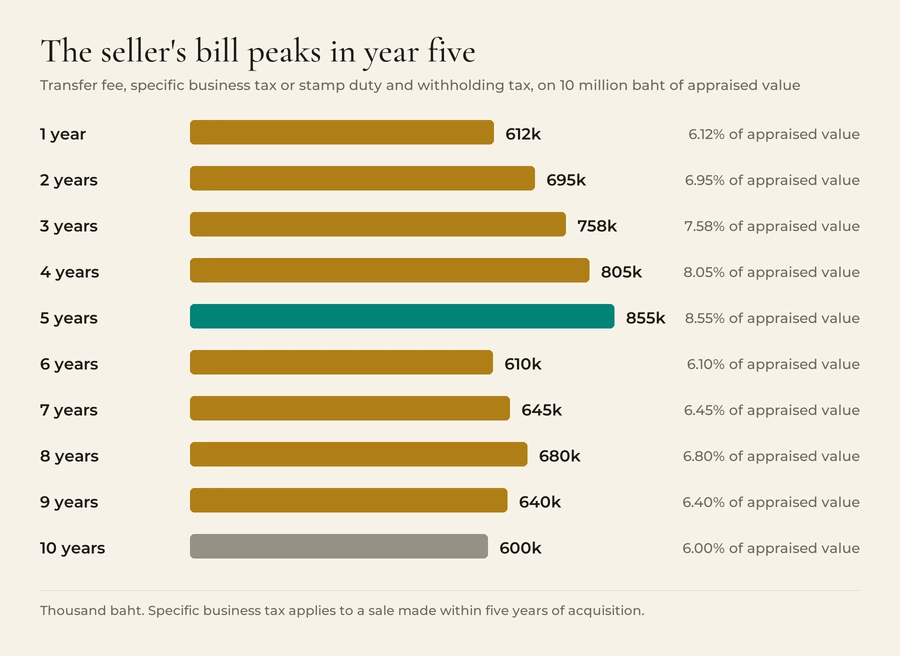
| Years held | Withholding tax | Business tax or stamp duty | Transfer fee | Total |
|---|---|---|---|---|
| 1 | ฿82,500 | ฿330,000 | ฿200,000 | ฿612,500 |
| 2 | ฿165,000 | ฿330,000 | ฿200,000 | ฿695,000 |
| 3 | ฿227,500 | ฿330,000 | ฿200,000 | ฿757,500 |
| 4 | ฿275,000 | ฿330,000 | ฿200,000 | ฿805,000 |
| 5 | ฿325,000 | ฿330,000 | ฿200,000 | ฿855,000 |
| 6 | ฿360,000 | ฿50,000 | ฿200,000 | ฿610,000 |
| 7 | ฿395,000 | ฿50,000 | ฿200,000 | ฿645,000 |
| 8 | ฿430,000 | ฿50,000 | ฿200,000 | ฿680,000 |
| 9 | ฿390,000 | ฿50,000 | ฿200,000 | ฿640,000 |
| 10 | ฿350,000 | ฿50,000 | ฿200,000 | ฿600,000 |
Year five costs 245,000 baht more than year six on the same property at the same price. Holding years are counted by calendar year and a part year counts as a whole one, so the boundary is a date on a deed rather than an anniversary. If a seller is close to it, the completion date is worth more to them than another round of haggling — and a buyer who understands that has something to trade.
How the withholding tax is actually computed
Almost every published Phuket fee guide prints this line as "sliding" and leaves it there. It is not vague. It is a four-step calculation set out in the Revenue Code and in the Revenue Department's own instruction to its officers, and you can run it before you reach the counter.
- Start from the appraised value. Not the price. Section 49 bis fixes the sale price for this purpose as the official appraisal used for collecting registration fees, whatever the property actually trades for — and in Phuket that appraisal sits well below what a villa trades for. Ask the Land Office for the figure on the specific deed; it is free.
- Deduct a standard expense allowance set by years of possession: 92% at one year, falling to 50% at eight years or more. What is left is the net income.
- Divide by the years held, capped at ten, and apply the schedule of income tax rates annexed to the Revenue Code.
- Multiply back up by the years held. The result is the tax, and it can never exceed 20% of the sale price.
Two things about that schedule catch people out. It starts at 5% from the first baht — the exemption of the first 150,000 baht that everyone knows from their annual return is a separate relief and is not part of the schedule itself. And because the allowance shrinks faster than the divisor grows, the withholding tax rises with the holding period over the first eight years, from 0.83% of the appraised value at one year to 4.3% at eight. It is the business tax falling away at five years that drives the total down, not the income tax.
One footnote worth recording, because it will otherwise be "corrected" back. The Revenue Department's own English translation of Royal Decree No. 165 gives the five-year allowance as 64%. The Thai text — which the translation itself states is the official language — gives 65%. We have used 65%. Every republished version of this table we found online also says 65%, so the English PDF appears to carry a typographical error rather than the other way round.
The tax that arrives every year afterwards
Transfer day is not the end of it. The Land and Building Tax Act B.E. 2562 has been in force since 2020, is assessed on whoever owns the land or building on 1 January, and is collected by the local authority rather than the Revenue Department. The Act caps residential use at 0.3% of the tax base, agriculture at 0.15% and everything else at 1.2%; the rates actually charged are set separately by Royal Decree and are a small fraction of those ceilings.
We are not printing a band table. The rate decree is published only as a scanned document we could not read, and this is not a figure to take second-hand. Your municipality or tambon administration publishes the schedule it bills on.
What does matter, and is not rate-dependent, is the exemption. A principal residence is exempt up to 50 million baht of appraised value where the owner holds both the land and the building, or up to 10 million where they own the building alone — but only where the owner's name appears in the house registration for the property on 1 January. A villa held for letting is not a principal residence, and a foreign buyer holding the land on a registered lease is not the owner of the land in the first place. For most of the houses we sell, the exemption is not in play and the tax runs from the first baht.
The 0.01% headline, and what it is worth here
The reduction of transfer and mortgage registration fees from 2% and 1% to 0.01% was extended again this year — two Ministry of the Interior announcements published in the Royal Gazette on 1 July 2026, following a Cabinet decision the day before, running to 30 June 2027. It requires the buyer to be a Thai national and caps the price, the appraised value and any mortgage at 7 million baht.
On our own book on 6 October 2026, 4 of the 633 priced, available villas and houses listed for sale were at or under 7 million baht. That is 0.6%, and every one of them would still need a Thai buyer. The measure is real and it is a genuine saving for the market it was written for. It is not written for this one.
Four places this goes wrong
- The SPA is silent on the transfer fee. It is the single most expensive unallocated line in the deal. Put the split in writing before the deposit, not on the day.
- Nobody asked how long the seller has held it. It decides 3.3% against 0.5% and it decides whether the seller will push the difference across the table at you.
- The seller assumes the withholding tax is final. It is a prepayment. A seller who paid specific business tax on a within-five-years sale may leave the proceeds out of their annual return entirely, but only if they claim neither a refund nor a credit for the tax withheld. That is a choice, and it should be made with an accountant rather than at the counter.
- The annual tax is forgotten at handover. Liability attaches to the owner on 1 January. A sale in March leaves a bill with a name on it.
The checklist for Land Office day
- Get the Land Office appraisal on the actual deed.
- Establish the seller's acquisition date, and whether the land and building were acquired at different times.
- Confirm whether the seller is an individual or a company — a company's withholding is a flat 1% and the arithmetic above does not apply.
- Get the transfer fee split written into the sale and purchase agreement.
- Check whether any Royal Decree No. 342 exception applies before accepting a 3.3% line on the statement.
- Bring a cashier's cheque. The Land Office does not take cards.
None of this is discretionary. It only looks opaque because the rates get quoted without their bases, and without the one variable — the holding period — that moves the total more than any of them. If you want the bill modelled on a specific villa rather than a round number, with the actual appraisal and the actual seller position, tell us what you are looking for and we will run it.