

Most people arrive at a Phuket villa purchase braced for the fee bill they know from home — five or six per cent of the price in tax, agency and legal, gone the day the keys change hands. Thailand does not work that way, and the difference runs in the buyer's favour more often than not.
The heavy transaction taxes here sit on the seller. What the buyer pays is a registration fee, some stamp duty and a lawyer. On the median villa on our own book — 21.9 million baht, taken by 30-year registered lease — that comes to roughly 278,000 baht, or about 1.3% of the price.
That is the good news. The bad news is that almost every published Phuket cost guide quotes rates without saying what they are charged on, and the base matters more than the rate. Below is every line, with the statute behind it, and the two places the arithmetic goes wrong.
First: what you are actually buying decides the bill
A foreigner cannot own land in Thailand. That is Section 86 of the Land Code, and no structure gets around it. A villa purchase therefore resolves into one of two shapes, and they carry completely different fees:
- A registered lease of the land, plus ownership of the house. Buildings are legally separate from the land beneath them, so the house can go into your own name while the land is leased. Leases of immovable property are capped at 30 years by Section 540 of the Civil and Commercial Code, and anything over three years must be registered at the Land Office to bind anyone.
- A Thai company that holds the land freehold. The company owns; you control the company. This is the more expensive route to set up and the more expensive one to maintain, and it carries obligations — real Thai shareholders, real accounts, an annual audit — that do not go away.
Everything that follows assumes the lease route unless it says otherwise, because that is what most of the villas we sell to foreign buyers actually do.
The seven steps, and where money leaves your hands
- Offer accepted. Nothing is payable. Nothing is binding either.
- Reservation deposit. A holding sum against a short exclusivity window — typically two to four weeks — while due diligence runs. Whether it is refundable if the title fails is a contract term. Read it before you send it.
- Due diligence. Your lawyer's title search at the Land Office: the deed itself, encumbrances, mortgages, access rights, building permits, and whether the seller is who the deed says. This is the one line where paying more is usually correct.
- Sale and purchase agreement, and the lease. Drafted bilingually. The Thai text governs.
- Remittance. Money comes in from abroad, in foreign currency, converted on arrival. Ask your bank for the Foreign Exchange Transaction record. It is not a condition of a lease registration, but it is the document that lets you take the money out again later, and it costs nothing to have.
- Land Office day. The lease is registered against the deed, the house is transferred, the fees and taxes are assessed and paid there and then, in cashier's cheque or cash. Both parties attend or send a properly executed power of attorney.
- Keys.
What the state charges
Six rates matter. They are all set by statute, none of them is negotiable, and each is charged on a different base.
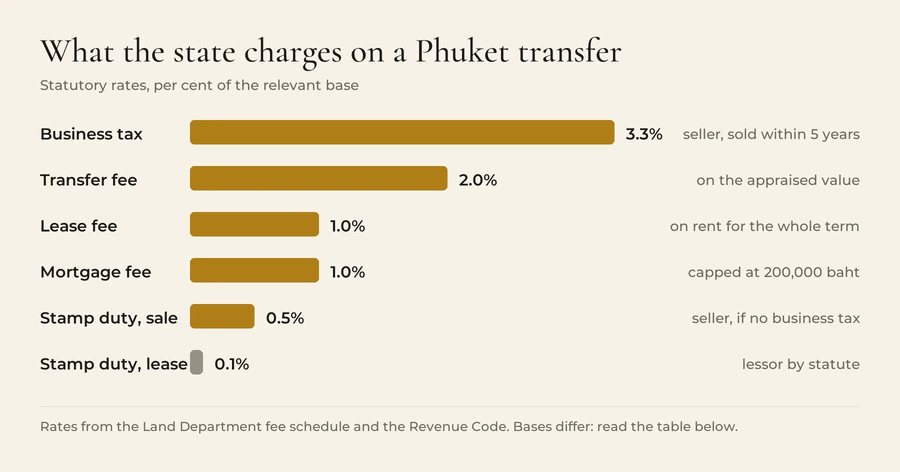
| Charge | Rate | Charged on | Paid by |
|---|---|---|---|
| Transfer registration fee | 2% | Land Department appraised value | Contract term |
| Specific business tax | 3.3% | Higher of appraised or contract price | Seller |
| Stamp duty, sale | 0.5% | Higher of appraised or contract price | Seller |
| Withholding tax | Sliding | Appraised value | Seller |
| Lease registration fee | 1% | Total rent for the whole term | Contract term |
| Stamp duty, lease | 0.1% | Total rent for the whole term | Lessor |
| Mortgage registration | 1% | Loan amount, capped at ฿200,000 | Borrower |
Three things in that table are worth slowing down for.
Specific business tax or stamp duty, never both. The 3.3% applies where the sale is commercial or profit-making — in practice, a seller who is a company, or an individual selling within five years of acquisition. Where it does not apply, the 0.5% stamp duty does instead. So the seller's bill is either 3.3% or 0.5%, and the five-year mark is the switch.
Withholding tax is not a flat rate. For an individual seller it is computed under Sections 48(4) and 50(5) of the Revenue Code: deduct a statutory expense allowance set by years of possession, divide by the years held, apply the personal income tax bands, then multiply back up. A long-held property produces a small number. It is a prepayment against the seller's income tax, not a separate tax.
Nothing here is charged on the price you agreed. Except the lease fees. Which brings us to the trap.
The appraised value is not the market value
The transfer fee, the withholding tax and — where it bites — the stamp duty are assessed on the appraised value: the official valuation used for collecting registration fees under the Land Code, set on a cycle by the Treasury Department, not by the market. Section 49 bis of the Revenue Code makes this explicit for the withholding calculation.
In Phuket that appraisal is routinely well below what a villa actually trades for. We are not going to publish a ratio, because we do not have one we can evidence across enough transfers to be honest about — it varies by district, by title and by when the parcel was last revalued. But the practical consequence is firm in both directions: you cannot compute a freehold fee bill from the asking price, and any guide that multiplies 2% by the price is giving you a number that is too high. Ask the Land Office for the appraisal on the specific deed. It takes a morning and it is free.
The lease route does not have this problem. The registration fee is 1% of the rent stated in the lease for the whole term — and on a Phuket villa lease, that stated rent is the price. It is the one number in the whole transaction you can calculate before you commit to anything.
The worked example
The median asking price across the 529 priced, available villas on our sale book on 25 August 2026 is 21,900,000 baht. Half of them fall between 15.5 and 35 million. Take that median villa on a 30-year registered lease:
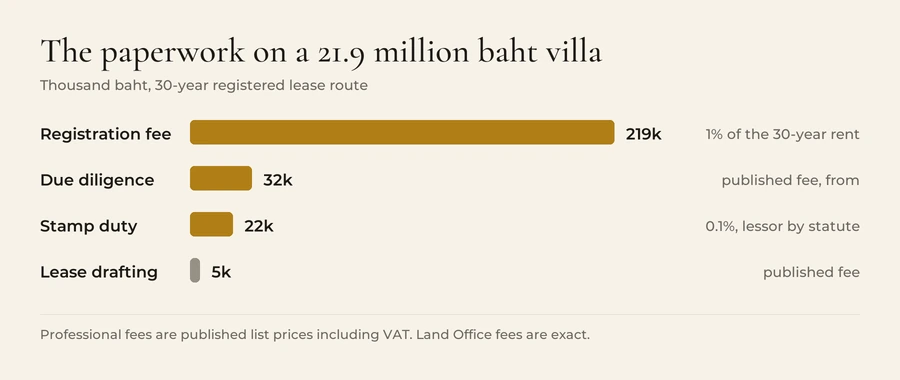
| Line | Amount | Basis |
|---|---|---|
| Lease registration fee | ฿219,000 | 1% of ฿21.9m rent for the term |
| Legal due diligence | ฿32,100 | From ฿30,000 plus 7% VAT |
| Stamp duty on the lease | ฿21,900 | 0.1% of the rent for the term |
| Bilingual lease drafting | ฿5,243 | ฿4,900 plus 7% VAT |
| Total | ฿278,243 | 1.27% of the price |
Of that, the stamp duty is the lessor's by statute and the 219,000 is whatever your contract says it is — the Land Code sets the fee, not who hands it over. The two professional lines are yours. The legal figure is a published starting price for a land-or-house due diligence; a weak title, a company structure or a superficies registration will take it higher, and on a villa at this price you should expect it to.
What you do not pay: agency commission. On our book the commission is contracted with the seller. A buyer who is being asked for one should ask why.
The 0.01% headline that does not apply to you
You will read that Thailand has cut its transfer fee to 0.01%. It has — the Ministry of the Interior extended the reduction on transfer and mortgage registration fees from 2% and 1% down to 0.01% each, running to 30 June 2027.
It applies to residential property where the price, the appraised value and the mortgage each come in at or under 7 million baht, and only where the buyer is a Thai citizen. A foreign buyer does not qualify. Neither does a 21.9 million baht villa. It is a genuine measure and a real saving for the people it was written for; it is simply not written for this market.
Five places this goes wrong
- The SPA is silent on who pays the registration fee. Then you are negotiating it at the Land Office counter with a cashier's cheque already drawn. Put the split in the contract.
- The price is split into a land sale and a construction contract. Common on new build. Services carry 7% VAT; a straight property transfer does not. Ask what each half of the number is, and what tax attaches to it.
- The money arrives as baht. Convert on arrival in Thailand, not before. A domestic baht transfer produces no foreign exchange record, and the record is what supports taking the funds out later.
- The lease is written as 30 plus 30 plus 30. Section 540 caps a lease at 30 years and a renewal can only be granted at the time of renewal. Pre-signed extensions are worth exactly what the lessor's goodwill is worth in 2056. Price the asset on 30 years.
- The company route is costed as a one-off. Registration is a published 45,000 baht plus government fees. The annual audit, accounts and nominee arrangements are the recurring cost, and they run for as long as you hold the villa.
The checklist
- Get the Land Office appraisal on the actual deed before you model any freehold fee.
- Confirm whether the seller is an individual or a company, and how long they have held it — that decides 3.3% versus 0.5% and whether they will push it at you.
- Get the registration fee split written into the SPA.
- Budget legal at the upper end, not the published floor.
- Remit in foreign currency and keep the bank's record.
- Read the lease's renewal clause knowing that a pre-agreed renewal is not enforceable.
- Take a cashier's cheque to the Land Office. They will not take a card.
None of this is complicated. It is only opaque, and it stays opaque because the numbers get quoted without their bases. If you want the fee bill modelled on a specific villa rather than a median — the actual appraisal, the actual seller position, the actual split — tell us what you are looking for and we will run it. You can also browse the developments we work with, or read our beginner's guide to investing in Phuket property for the ground underneath all of this.