
Most rental fraud in Thailand asks for the same thing: money transferred before you have a key, a contract or any proof that the person taking it can let the house. On a Phuket villa that money is large. A three-bedroom house on a twelve-month lease usually asks two months' deposit and one month in advance, which at the median three-bedroom asking rent on our book, ฿120,000, is ฿360,000 before you have slept a night in it.
This guide is for anyone renting a villa or house for a year or more. It is built from public sources only: the Thai Bankers' Association's published list of accommodation-fraud signs, the Anti Online Scam Operation Center's own page at the Ministry of Digital Economy and Society, the Department of Lands, the 2025 Royal Gazette notification on residential leases, and our own catalogue of villas to rent, all read on 3 November 2026. It is general information, not legal advice, and it does not draw on any case records: none of these sources, and nothing here, counts how often each scam happens.
The short version
- A rent far below what comparable houses ask is the first sign. It is not proof of fraud, but it is a reason to check everything else twice.
- Never transfer money for a house you have not seen, in person or on a live video call you control.
- Pay only into an account in the name on the contract, and be wary of a personal account belonging to someone who is neither the owner nor a registered company.
- Ask for the title deed and the owner's identity, or a written authority from the owner, before you pay.
- If you have already paid, call 1441 at once. It is the government's anti-online-scam line, open 24 hours, and pressing 1 asks for the receiving account to be frozen.
Six warning signs
In December 2024 the Thai Bankers' Association published six signs of accommodation fraud on online platforms. It wrote them for holiday bookings, but every one of them applies to a long let, where the sums are many times larger. The six below follow its list, adapted to a twelve-month lease, with what you can check for each.
1. The rent is well below what similar houses ask
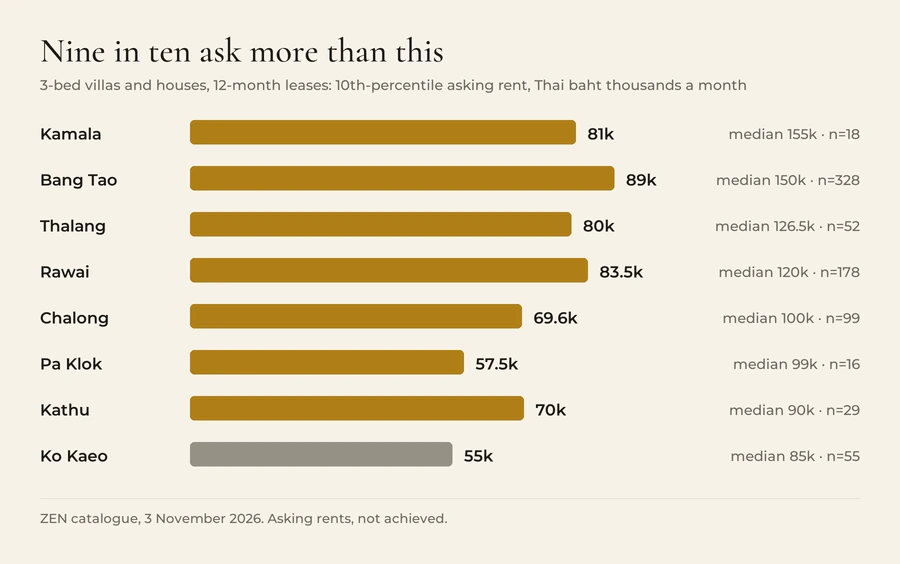
The Association's second sign is accommodation "priced unrealistically low", advertised with attractive photos, usually with a deposit demanded in advance. On a long let you can put a number on "unrealistically low". On 3 November 2026 our book held 1,829 priced, available rentals, 1,800 of them on twelve-month minimum leases. Of those, 806 were three-bedroom villas, houses or townhouses, and the chart shows the asking rent below which only one in ten of them sat, district by district.
| District | Listings | One in ten ask less than | One in four ask less than | Median |
|---|---|---|---|---|
| Kamala | 18 | ฿81,000 | ฿138,750 | ฿155,000 |
| Bang Tao | 328 | ฿89,000 | ฿113,750 | ฿150,000 |
| Thalang | 52 | ฿80,000 | ฿88,750 | ฿126,500 |
| Rawai | 178 | ฿83,500 | ฿95,000 | ฿120,000 |
| Chalong | 99 | ฿69,600 | ฿85,000 | ฿100,000 |
| Pa Klok | 16 | ฿57,500 | ฿77,500 | ฿99,000 |
| Kathu | 29 | ฿70,000 | ฿85,000 | ฿90,000 |
| Ko Kaeo | 55 | ฿55,000 | ฿66,500 | ฿85,000 |
These are asking rents, not signed ones, and the cheap end of any district holds genuine houses: older, smaller, further from the beach. A pool villa in Bang Tao advertised at ฿60,000 is not automatically a fraud. It is a listing below what nine in ten comparable houses on our book ask, and that is the point at which to insist on the other five checks.
2. The page or profile is new, or copies a real one
The Association's first sign is a fake website or page that borrows a real property's name and logo until the two cannot be told apart. Its advice is to look at when the page was created, and to be suspicious if it is recent. For a long let, two further checks are cheap: ask for the listing on the agency's or owner's own website, and ask for a viewing at the address rather than a meeting point nearby. A house that exists can be visited.
3. You are hurried into paying before you have seen it
Two of the six signs are about speed: promotions designed to make the victim "rush to transfer money without checking", and a person claiming to be the owner or agent who presses for payment in advance. On a long let the pressure usually comes as another tenant who is said to be ready to pay today. A real landlord with a good house at a fair price can wait the day it takes to view it. Do not transfer a reservation fee, a deposit or a first month's rent for a house you have not seen, either in person or on a live video call in which you choose what the camera shows.
4. The money goes to a personal account that matches nobody
The Association's advice is to check carefully before any transfer, "especially transfers into a personal account". Scam money moves through accounts opened in other people's names, which Thai banks and regulators call mule accounts. The rule for a tenant is simple: the account you pay should be in the name of the owner on the title deed, the company on the lease, or the agency you are dealing with, and that name should appear on the contract you sign. If the name on the account is a third person's, ask why, in writing, before paying.
5. The person cannot show the right to let the house
The sixth sign is a scammer posing as the owner or agent, sometimes with forged documents. Ask for a copy of the title deed and the owner's identity document, and if you are dealing with anyone else, a written authority signed by the owner. A tenant cannot sublet without the landlord's consent unless the lease allows it (Civil and Commercial Code, section 544), so a "current tenant" offering the house needs that consent in writing too.
A title deed can be checked in part. The Department of Lands' free LandsMaps service, at landsmaps.dol.go.th or in the SmartLands app, takes a province, a district and a deed number and returns the plot: its deed and survey numbers, sub-district, area, appraised value and location on the map. The Department does not say it shows the owner's name, so it confirms that a deed and a plot match, not who owns them. If the map puts the deed somewhere other than the house you were shown, stop.
6. The paperwork breaks the rules, or does not exist
A lease of immovable property cannot be enforced without written evidence signed by the party liable (section 538 of the Code). No written lease means no tenancy you can enforce. Where the landlord lets three or more units, the 2025 notification on residential leases also applies, and a twelve-month lease falls under its short-term model contract, which covers terms of up to three years. Under it, such a landlord may not:
- take deposit and advance rent that together exceed three months' rent;
- keep the deposit or advance rent when the tenant is not at fault;
- charge more for electricity or water than the utility charges the landlord;
- raise the rent before the lease ends.
The contract must be in Thai, the tenant gets a copy at signing, and a record of the property's condition is attached. A demand for six months up front, or a refusal to put any of this in writing, is a reason to walk away. Our guide to getting a deposit back covers the notification in full, and the lease clauses that matter covers the rest of the contract.
Before you pay: a checklist
- Compare the rent with the district table above.
- Find the listing on the owner's or agency's own website.
- View the house, at its address, or on a live call you direct.
- See the title deed, the owner's identity document and, for anyone else, the owner's signed authority.
- Check the deed number on LandsMaps against the location you were shown.
- Read a written lease that names the account you will pay into.
- Pay only into that account, and keep the transfer slip.
If you have already paid
- Call 1441 straight away. The Anti Online Scam Operation Center runs it every day, 24 hours, and the Ministry's page says the number is its only channel, with no social-media contact. Press 1 to ask for a suspect account to be frozen. You should receive an SMS from the police within 24 hours with a Police Case ID, and you then have seven days to see an investigating officer at a police station. Be wary of websites that look like the centre's; the Ministry's page names no other channel.
- Tell your own bank, which the Bank of Thailand names alongside 1441 as the place to go with a suspect account.
- Report online at thaipoliceonline.go.th, the police's online-crime reporting site, which the Cyber Crime Investigation Bureau directs victims to.
- Call the Tourist Police on 1155 if you need help in English. The hotline is open 24 hours in eight languages.
- For a genuine landlord breaking the notification's rules, the Office of the Consumer Protection Board takes complaints on 1166.
Where to start
Every one of the 1,829 rentals counted above is published on our own website with its price, and 1,800 of them carry a twelve-month minimum. Whoever you rent through, us included, the same six checks apply, and a landlord or agent with nothing to hide will answer all of them before you pay. Ask us for the title deed and a viewing on any house on the book.
Browse villas for long-term rent or tell us what you are looking for, and we will arrange the viewings.