
The price of a Phuket villa is quoted to the baht. What it costs to keep is seldom in the listing. On 17 November 2026 our own book held 1,028 villas, houses and townhouses for sale with a published price. We searched their descriptions for the usual words: common area, estate fee, maintenance fee, service charge, sinking fund. Two state an estate charge as a figure, ฿9,000 and ฿15,000 a month. Two say there is none. The other 1,024, ours included, do not say.
This guide builds that annual number from what is published: the electricity and water tariffs, the estate charges developers put on their price lists, and the land and building tax. Where a cost has no published price anywhere we could find, we say so and tell you what to ask for instead. The figures are dated, and every source is listed at the foot of the page.
The annual number for one villa
To make it concrete, take the middle of our book. On 17 November the median three-bedroom villa for sale asked ฿21.0 million (413 listings), and the median built area was 300 sq m (412 of them state one). Here is what a year costs on the lines that have a published price, with the consumption we assumed stated so you can replace it with your own.
| Annual line | Basis | A year |
|---|---|---|
| Estate charge | ฿30 per sq m a month on 300 sq m, the middle of the developer lists below | ฿108,000 |
| Electricity | 1,500 units a month at PEA's household tariff | ฿83,376 |
| Water | 40 m³ a month at PWA's Phuket rates, with the meter charge and VAT | ฿8,911 |
| Land and building tax | 0.02% of the appraised value; shown here on the full asking price | ฿4,200 |
| Priced total | ฿204,487 | |
| Pool service, garden, cleaning, insurance, repairs | No published price found | Ask for invoices |
That is just under 1% of the asking price a year, before a single pool clean. It is a floor, not a budget: the lines in the last row are real, but we found no published price for them that we could stand up. The rest of this guide goes through each line in the order to check it.
1. Get the estate charge in writing, with its basis
Most villas on our sale book are part of a named project: 591 of the 1,028 carry one on the listing. An estate charges its owners for whatever it runs in common, and what that covers differs by estate. It is the one running cost set by a private party rather than a tariff, so it is the one to read most carefully.
The best public record we have of it is the developer price lists held on our project pages, read from the developers' feed between 29 October and 5 November 2026. Of 165 projects with a price list there, 100 state an estate charge we could read as an annual figure. A further 53 leave it blank, and 12 give a number we could not interpret. Several of those are recorded as a rate "per square metre per month" of ฿6,000 to ฿144,000, which only makes sense as a monthly or yearly charge for the whole villa. We left all 65 out rather than guess.
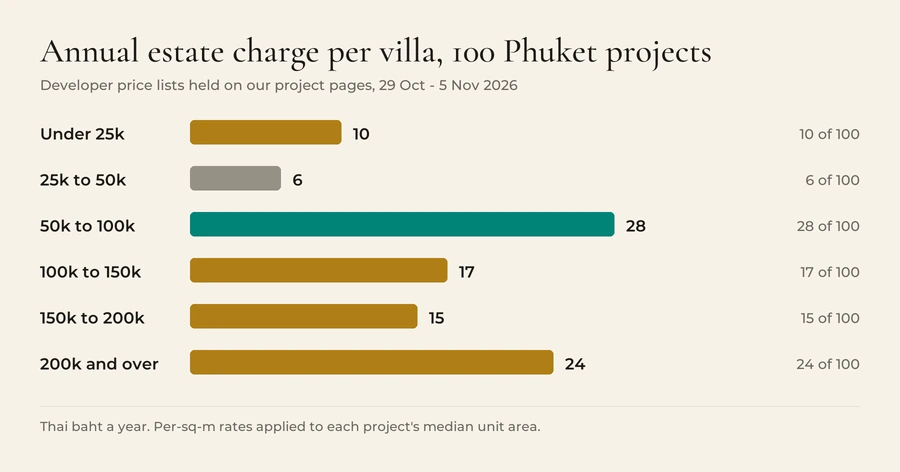
The spread is the finding. Ten projects charge under ฿25,000 a year, and 24 charge ฿200,000 or more. The gap between those two groups is larger than the whole electricity bill in the example above. The 68 projects that charge by area ask a median of ฿30 per square metre a month, with the middle half between ฿20 and ฿50. The 32 that charge a flat sum per villa ask a median of ฿69,000 a year.
A rate per square metre is only half an answer. Square metres of what? Plot, total built area and internal living space are three different numbers on the same house. Our Trichada review found a three-bedroom plan with 121 sq m of internal space and 221 sq m "total built up". In our Laguna review, a developer's own resale desk gave a rate of ฿150 per square metre a year without saying which area it meant, and marked the fee on two other units "TBC". Before you sign, get three things in writing: the rate, the area it is charged on, and what it pays for.
Many estates also take a one-off sinking fund at transfer. On the same price lists, the 47 projects that charge it per villa ask a median of ฿100,000, and 49 more charge it per square metre. That belongs in the purchase budget, not the annual one. Our guide to every fee between offer and keys sets out the rest of that bill.
2. Ask for the seller's electricity bills
Phuket is supplied by the Provincial Electricity Authority. Its household tariff changed with the September 2026 bills. A home using more than 150 units a month now pays ฿3.0000 a unit for the first 200, ฿4.1584 from 201 to 400 and ฿4.3583 for every unit above 400, plus a ฿24.62 monthly service charge. On top sits the fuel adjustment charge, the Ft, which the Energy Regulatory Commission set at 16.23 satang a unit for September to December 2026, and then 7% VAT.
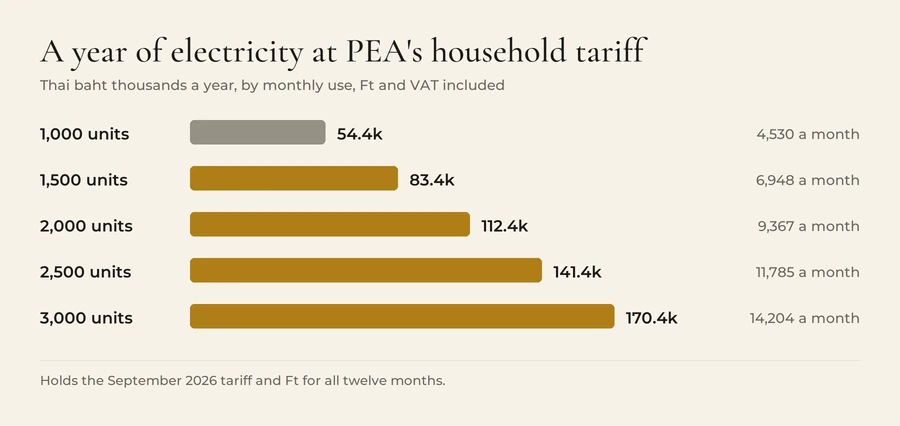
Above 400 units, every unit costs about ฿4.84 once Ft and VAT are in. What decides how many units a villa uses is air conditioning running at night and how long the pool pump runs, and no listing tells you either. A resale has one advantage over a new build here: the house has a history. Ask the seller for the last twelve PEA bills. They show the dry season and the wet one, and they cost the seller nothing to hand over.
The same PEA notice also changed who the household tariff covers. Since September it extends to continuous residential use at an address that does not yet have a permanent house registration, provided there are at least six months of payment history and the occupier applies to PEA with the documents. That matters for a new house still waiting for its house number. Ask which tariff the meter is on.
3. Water: cheap until the pool needs topping up
The Provincial Waterworks Authority prices Phuket on its own table, shared with Samui and Phangan. A household pays ฿10.20 a cubic metre for the first 10, rising in bands to ฿21.20 between 31 and 50, so 50 cubic metres comes to ฿876. Above 50 in a month, PWA charges a household at the next user type's rate from the 51st cubic metre, which on the Phuket table is ฿24.00 up to the 80th. Sixty cubic metres is ฿1,116 a month. PWA's customer guide adds a ฿30 monthly charge on a half-inch meter, and both carry 7% VAT. A pool topped up from the mains through the dry season is how a villa crosses that line.
Some estates run their own supply, and some houses draw on a well. One listing on our book offers exactly that, a well "eliminating water costs". An estate's water charge is not on PWA's schedule, so ask for it the same way as the estate fee.
4. The land and building tax
The Land and Building Tax Act B.E. 2562 is assessed every year on whoever owns the land or the building on 1 January, and is collected by the local authority, not the Revenue Department. The rates are set by a Royal Decree of 2021 (B.E. 2564), and the Department of Local Administration's own guide to the 2026 collection confirms that it is still the decree in force. For a home that is not the owner's registered residence, the bands are marginal:
| Tax base | Rate |
|---|---|
| Up to ฿50 million | 0.02% |
| ฿50 million to ฿75 million | 0.03% |
| ฿75 million to ฿100 million | 0.05% |
| Over ฿100 million | 0.1% |
The base is the official appraised value of the land and building, not the price you paid, and we do not hold that figure for any house on our book. As a sense of scale only: if the base were the full ฿21.0 million asking price of our example villa, the tax would be ฿4,200 a year. It is the smallest line in the table by a long way.
Where an individual owns the land and the house and has their name in the house registration for it on 1 January, the first ฿50 million of the base is exempt; where they own the building alone, the first ฿10 million. Our guide to transfer fees and the annual tax explains why that rarely fits a let villa or a foreign buyer holding land on a lease. The DLA guide sets June as the payment month for 2026, and a local authority can extend it. Ask the seller for the last demand and the receipt: liability attaches to whoever owned the house on 1 January, so a purchase in March leaves that year's bill with the seller's name on it.
5. The lines with no published price
Several running costs of a pool villa have no published price: a pool service, a gardener, cleaning, house insurance, air-conditioner servicing, pest control and repairs. We found no Phuket price schedule for any of them that we could stand up against a company's own page, so they are not in the table above.
One floor does exist. A gardener or housekeeper you employ directly is owed at least the provincial minimum wage, which for Phuket is ฿400 a day under the Wage Committee's Announcement No. 14, in force since 1 July 2025 and the latest general announcement we found. A pool or garden company quoting a monthly contract is a different price, and an unpublished one.
The way to price these on a resale is the same as electricity. Ask the seller for the last year of invoices and contracts: pool, garden, cleaning, pest control, insurance, and any repair over ฿20,000. A seller who has them is showing you how the house has been kept. A seller who has none is telling you something too.
6. If you let it on a long lease
A buyer who will not live in the house all year may let it, and a twelve-month let changes the arithmetic. Who pays for electricity, water, the pool and the garden is a term of the lease, not a fact about the house: our guide to what a Phuket villa rental includes found no listing field on our book that records it. The estate charge and the land and building tax are billed to the owner.
That is why our district yield analysis is a gross figure, before fees, management, maintenance, tax and empty months. On the example above, an estate charge of ฿108,000 is about half of one percent of a ฿21.0 million asking price, before the tax and before the costs with no published price. Run your own numbers with the estate's real charge, not the median. If you want to see what your villa would ask on a twelve-month lease, list it with us and our rentals team will tell you.
The checklist before you sign
- The estate charge in writing: the rate, the area it is charged on, what it covers, and when it last rose.
- The sinking fund at transfer, and whether the estate can call for more.
- Twelve months of PEA bills, and which tariff the meter is on.
- The water source: PWA, the estate, or a well, and the last year of bills.
- The last land and building tax demand from the local authority, and whether it was paid.
- A year of invoices for the pool, garden, cleaning, insurance and repairs.
All of it is easier to ask for before transfer than after.
Where to start
Every PEA household pays the same electricity tariff; the estate charge is what differs from one house to the next, which is a reason to look at specific houses rather than averages. Our villas for sale name the project where the house is in one, and the project pages carry the developer's estate charge where the developer states one. If you would rather be sent a shortlist, the sale quiz takes two minutes, and you can ask our sales desk to request the estate charge and the bills from the seller before you view.