
Freehold is the word that sells a Phuket condominium to a foreign buyer, and it is a real thing. A unit registered in your own name, on the same title a Thai buyer takes, with no lease behind it and no company around it. It is the only route on which a foreign individual owns Thai real estate outright.
It is also rationed. Section 19 bis of the Condominium Act caps the foreign side of every building, and the cap is not a formality. It is checked at the Land Office on the day you transfer, by an official who has to add your square metres to everybody else's before he registers anything. Buildings run out.
Most of what is written about the quota is roughly right and precisely wrong. What follows is read from the consolidated Thai text the Office of the Council of State maintains and the Department of Lands publishes, checked on 24 September 2026.
1. The quota is on floor area, not on units
Section 19 bis, in the form given to it by the fourth amending Act of B.E. 2551, says that the foreigners and foreign juristic persons listed in section 19 may hold units in a condominium which, combined, must not exceed 49 per cent of the area of all the units in that condominium at the time of applying to register the condominium under section 6.
Three things follow from that sentence, and each of them decides real cases.
Area, not count. The measure is square metres of unit, not how many doors. A building whose foreign half has been taken up by a handful of large penthouses can still have dozens of small units left that it cannot sell to you freehold. The reverse happens too: a tower of studios can absorb a lot of foreign buyers before the area runs out. You cannot read the position off the number of units sold.
Fixed at registration. The denominator is the area of all units as it stood when registration was applied for under section 6. It is a number from the building's past, not a live figure, and nothing that happens afterwards moves it.
Per registered condominium. The Act sets the limit for each condominium — the entity registered under section 6 — not for a development as it is marketed. A scheme sold under one name across several buildings may be more than one registered condominium, each carrying its own 49%. Ask which registered condominium your unit sits in before you ask how full it is.
2. Five doors, and almost everyone walks through the fifth
Section 19 lists who may hold a unit at all. There are five categories, and they are narrower than the conversation around them suggests.
| Section 19 | Who it covers |
|---|---|
| (1) | A foreigner permitted to have residence in the Kingdom under the immigration law |
| (2) | A foreigner permitted to enter under the investment promotion law |
| (3) | Juristic persons under sections 97 and 98 of the Land Code, registered as juristic persons under Thai law |
| (4) | Foreign juristic persons under Revolutionary Council Announcement No. 281 holding an investment promotion certificate |
| (5) | A foreigner or foreign juristic person who brings foreign currency into the Kingdom, withdraws from a non-resident baht account, or withdraws from a foreign currency deposit account |
The fifth door is the one nearly every private buyer uses, and it is not a status you hold. It is a transaction you perform. Section 19 ter (5) sets the proof: the buyer must show the official evidence of that inward currency, of that non-resident baht withdrawal, or of that foreign currency account withdrawal, in an amount not less than the price of the unit to be purchased.
Not part of the price. Not most of it. Not less than the price of the unit.
3. The money has to arrive from outside, and the paperwork is yours to chase
The Bank of Thailand's published summary of exchange control regulations says that for transactions equivalent to USD 200,000 or above, authorised banks must ask the customer for supporting documents, except where the bank has already run its Know Your Business process — and that after conducting a transaction, banks will issue evidence of it to the customer.
Here we have to record a disagreement rather than resolve it. Most Thai property guidance gives the threshold as USD 50,000 and calls the document a Foreign Exchange Transaction form. The Bank of Thailand's own current summary gives USD 200,000 and does not use that term anywhere on the page. We could not reconcile the two from the Bank's site, and we are not going to pick a side quietly. Ask your receiving bank, in writing and before you send, what document it will issue and at what size.
The arithmetic matters here because most Phuket units are small. The median one-bedroom on our book asks ฿4,721,900, which is below USD 200,000 at any exchange rate above ฿24 to the dollar. On a typical unit, in other words, the bank is under no obligation to ask you for anything at all. The Act's evidence requirement has no threshold. So the document you need at the Land Office is one you will have to request.
Two readings of section 19 ter (5) worth acting on. The first: the three things it accepts are foreign currency brought in, a non-resident baht withdrawal, and a foreign currency account withdrawal. A payment sent from abroad already converted into baht is none of those on the face of the Act, so send foreign currency and let it convert on arrival. The second: it is the transferee who must produce the evidence, so the money should arrive in the buyer's own name. Neither point is spelled out in the section; both are what it says read plainly, and both are cheap to get right and expensive to get wrong.
4. What the freehold route actually costs
Our book held 2,576 priced, available Phuket listings on 24 September 2026, of which 725 are for sale. Eighty-nine of those are condominium units — 12.3% of everything we have on sale. This is a narrow shelf, and it is a cheap one by Phuket standards.
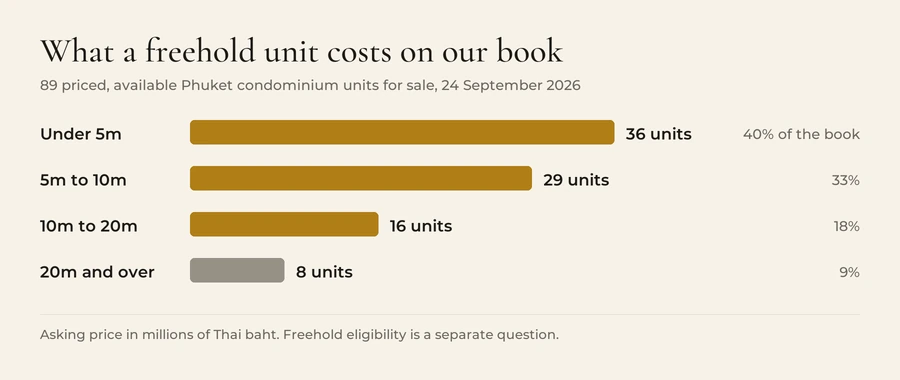
The median unit asks ฿5,700,000 against a median of ฿22,895,000 for the 594 villas beside it. That is the comparison people make, and it is the wrong one. Measured per square metre the freehold route is the dearer asset: a median of ฿117,500 per square metre across the 89 units, against ฿72,242 across 588 villas — about 63% more for each metre you buy. The median unit is 45 square metres. The median one-bedroom is 37.
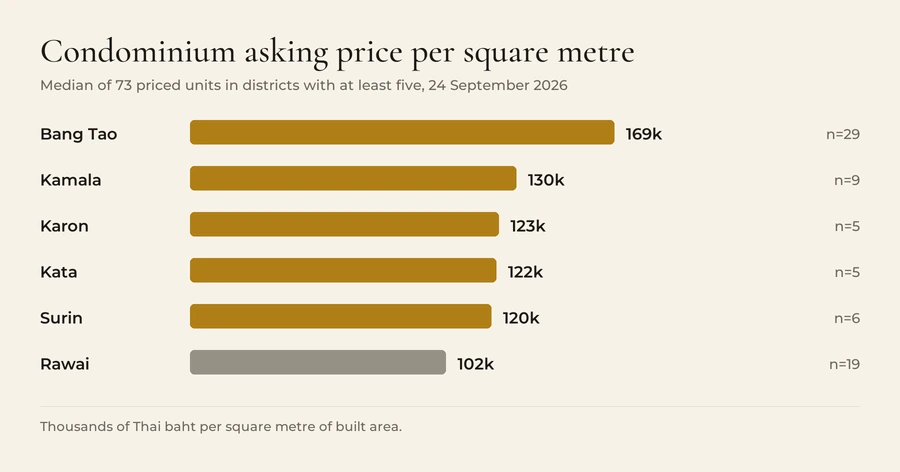
Buying freehold is not a safer version of the villa you were looking at. It is a different building, in a different place, at a different price per metre. Our development listings and our guide to the fees between offer and keys set out what the rest of the transaction costs either way.
5. What happens when the foreign side is full
Two things get offered, and they are not equivalent.
The first is a registered lease of the same unit. That is a legitimate instrument and we have written about what thirty years really buys. What it is not is the thing the brochure said. If a unit was marketed as freehold and is now offered on a lease because the quota is exhausted, the asset has changed and the price should change with it.
The second is a Thai name on the title with an agreement behind it. Section 67 of the Act is unusually direct about this: anyone who holds ownership of a unit as owner on behalf of a foreigner — whether or not that foreigner would have been entitled to own it — faces imprisonment of up to two years, or a fine of up to ฿20,000, or both, and the unit is subject to forced disposal. The fine is trivial. The prison term and the forced sale are not, and they fall on the Thai national who signed as much as on the buyer who arranged it. The longer treatment is in our piece on how foreigners actually hold Phuket property.
The Act also has teeth pointed at owners who fall out of the quota rather than buy into it. Under section 19 quinque, a foreigner who inherits a unit that pushes the building over 49%, or who loses the residence permit or investment promotion that qualified them, must notify the official in writing within sixty days and dispose of the unit — the excess only, in the inheritance case — within one year. Miss the year and the Director-General of the Department of Lands has the power to dispose of it for you. Miss the notification and section 66 sets a fine of up to ฿10,000 plus ฿500 for every day it runs.
6. The checks to run before you pay anything
- Ask the condominium juristic person, in writing, for the building's current foreign-quota position and the registered total unit area — with the question addressed to your specific unit, not the development.
- Ask which registered condominium your unit belongs to, if the scheme has more than one building.
- Establish which of the five section 19 doors you are going through, and get the evidence for it before you commit.
- Ask your receiving bank what document it will issue, and at what size, before the money leaves.
- Send foreign currency, in the buyer's name, for not less than the price of the unit.
- Keep the bank's certificate. It is the only record that the purchase money came from abroad.
- Use your own lawyer. We are a selling agency and our commission comes from the seller; that is exactly why the conveyancing opinion should not come from us.
One honest limit on all of this. Our listing data records how a property is marketed — never its quota position. No field on our book, and none on any Phuket portal we have seen, carries a building's foreign-side capacity, because it is not a fact about a listing. It lives in the juristic person's own register, and the only way to learn it is to ask them in writing and keep the reply.
If you would rather start from what you are trying to achieve than from what is available, our sale quiz takes a few minutes and puts a real person on the other end of it.