
Most foreign buyers of a Phuket villa pay for it with money earned somewhere else, and the transfer is the one part of the purchase that runs on the banks' rules rather than the Land Office's. Those rules are short and published. The trouble is that the guidance repeated across property sites describes a form and a threshold that the Bank of Thailand's own summary does not mention. This guide works from the central bank's pages and from what two Thai banks publish for incoming transfers, all read on 10 November 2026.
The short version: send foreign currency from your own account abroad, say in the payment that it is for buying property, have the contract ready for the receiving bank, and keep every record the bank gives you. The rest of this page explains why each of those four things matters.
What the Bank of Thailand actually says
The Bank of Thailand's summary of its exchange control rules is the primary text, and four lines in it carry almost everything a buyer needs.
- No limit on what comes in. "Foreign currencies or baht can be transferred or brought into Thailand without limit."
- Documents from USD 200,000. Anyone buying, selling, depositing or withdrawing foreign currency with a bank must give the bank the details. "For transactions in an amount equivalent to USD 200,000 or above," the bank must ask for supporting documents, unless it has run a Know Your Business check on the customer.
- The bank issues the evidence. "After conducting the transactions, authorized banks will issue evidence of such transactions to the customers." That evidence is the document most guides call the FET form.
- The money can leave again. "Repatriation of such investments by non-residents" is "freely allowed", and a non-resident baht account may be used for "investment in immovable assets".
The summary does not use the phrase "Foreign Exchange Transaction form" anywhere, and it gives USD 200,000 as the documents threshold, not the USD 50,000 that most property guides print. We are not saying the guides are wrong about every bank, only that the central bank's own page says something different. See the next section for why both numbers can be true at once.
The December 2025 tightening
On 29 December 2025 the Bank of Thailand announced stricter checks on money coming in, effective the same day. The release is in Thai; the English page returned an error when we looked. It says that when a Thai resident sells foreign currency for baht, or receives it into a foreign-currency account, in a transaction of USD 200,000 or more, the bank must check documents for every transaction to confirm the money's source matches what the customer declared. Regular business customers the bank already knows well are normally exempt.
That exemption does not apply where the foreign currency comes from certain sources, and the first one on the list is income from selling real estate to foreigners. In plain terms: when a Thai developer or a Thai seller converts the dollars, pounds or euros you paid them, their bank must see the paperwork every time, however well it knows them. Expect the seller's side to ask you for a copy of the contract and your payment details, and send them without being asked twice.
What the receiving banks publish
Banks can ask for more than the central bank's minimum, and at least one says so on its own page. Siam Commercial Bank asks for "supporting documents as per the remittance purpose in compliance with the Bank of Thailand's requirements for amounts starting from USD 50,000 or equivalent, including a Foreign Currency Transaction Form." So the USD 50,000 figure is real at SCB, and the form has a name there, even though neither appears in the central bank's summary.
Bangkok Bank says there is no limit on the amount, but "senders must specify the purpose of the money transfer for every transfer", because banks report it to the Bank of Thailand. A SWIFT transfer should arrive in one to two working days, and the bank converts foreign currency at its telegraphic transfer buying rate. Its condominium answer adds a point that applies to any purchase: after the money arrives, ask the branch for the documents you will need, rather than finding out at the Land Office that you do not have them.
| Bank (own page, 10 Nov 2026) | Fee to receive | Documents asked for |
|---|---|---|
| Bangkok Bank | 0.25%, minimum ฿200, maximum ฿500 | Purpose stated on every transfer |
| Siam Commercial Bank | 0.25%, minimum ฿300, maximum ฿500 | Supporting documents and a Foreign Currency Transaction Form from USD 50,000 |
| Bank of Thailand rule, all banks | — | Supporting documents from USD 200,000 |
The receiving fee is capped at ฿500 at both banks, which on a villa price is a rounding error. The cost that matters is the exchange rate. Your own bank's outgoing fee and the margin built into whichever rate converts the money are not published by the Thai side, so ask both banks for their rate on the day, in writing, before you send a large sum.
The threshold is not an edge case
On 10 November 2026 our book held 1,010 villas and houses for sale with a published price, every one priced in baht. At Bangkok Bank's telegraphic transfer buying rate of ฿33.35 to the dollar, published on 9 November 2026, USD 200,000 is about ฿6.67 million. 1,007 of the 1,010 ask at least that. The cheapest asks ฿4.5 million. The median asks ฿26 million.
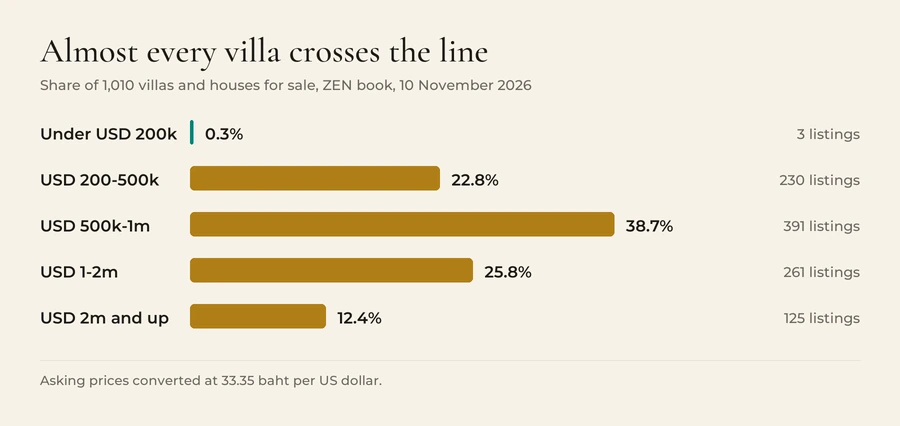
| Asking price in US dollars | Listings | Share |
|---|---|---|
| Under 200,000 | 3 | 0.3% |
| 200,000 to 500,000 | 230 | 22.8% |
| 500,000 to 1 million | 391 | 38.7% |
| 1 to 2 million | 261 | 25.8% |
| 2 million and up | 125 | 12.4% |
Paid in one transfer, almost any villa on our book crosses the documents line. Plan for it rather than hoping to avoid it. Do not try to break a payment into smaller transfers to stay under a threshold. The Bank of Thailand's stated aim is to stop money arriving from a source other than the one declared, and splitting a payment to dodge the line invites exactly the question the rule is there to ask.
Off-plan: one purchase, several transfers
An off-plan villa is paid in stages, and each stage is its own transfer with its own paperwork. Anchan Villas publishes a typical schedule on its project pages: 2% to reserve, 28% at contract within 30 days, four payments of 15% at construction milestones, and 10% at transfer and land registration. Applied to the median off-plan asking price on our book, ฿34.65 million across 351 listings, it looks like this.
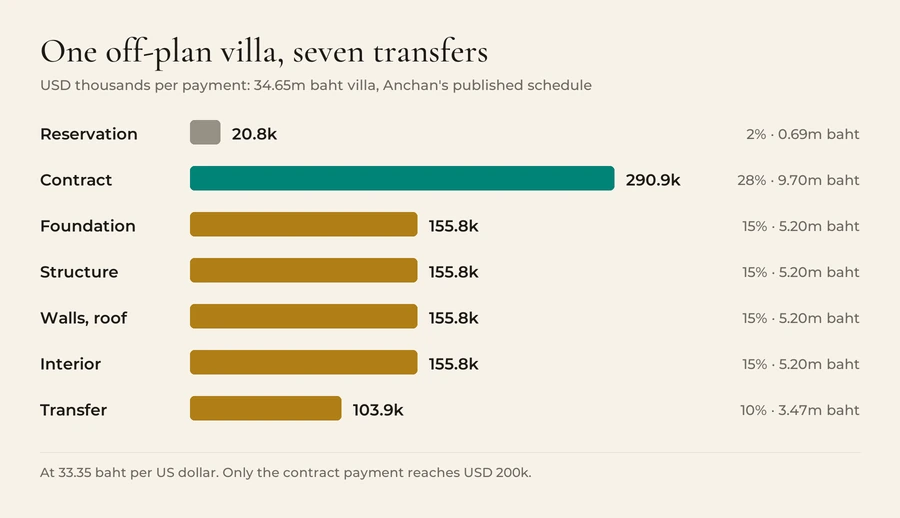
Two things follow. Only the contract payment crosses the Bank of Thailand's USD 200,000 line, but every payment after the reservation crosses SCB's USD 50,000 one, so at a bank that applies the lower figure you should expect to send documents six times. And the baht price is fixed while your currency is not: between the contract and the last milestone, months or years apart, the same baht instalment can cost noticeably more or less in your money. Budget for that rather than for today's rate. Our guide to protecting an off-plan deposit covers what to check before any of those payments.
Step by step
- Agree in the contract where each payment goes. A developer's or seller's account in Thailand, or your own Thai account first. Bangkok Bank recommends opening an account with it before buying; without one, it says, purchase money goes to the developer's account or a third party's. Put the account name and number in the contract and confirm them by phone before the first payment, never from an email alone.
- Send foreign currency, from an account in your own name. The Bank of Thailand's evidence is created when foreign currency is converted or deposited in Thailand. A domestic baht transfer creates none.
- State the purpose in the payment instruction. Something plain such as "purchase of villa, [project or plot], buyer [your name]". Bangkok Bank reports the purpose of every incoming transfer to the central bank.
- Send the documents with the money. At USD 200,000 or more the receiving bank must ask; at SCB from USD 50,000. Have a copy of the signed contract or reservation agreement, your passport and the payment confirmation ready for the receiving side.
- Collect the bank's record of each transfer. Ask the receiving bank, in writing, for its evidence of the foreign-currency transaction and keep one for every payment. It is what supports taking the money back out when you sell.
- Do not carry cash. Foreign banknotes over USD 15,000 must be declared to Thai Customs on arrival, and Bangkok Bank says banks will not accept a large amount of foreign cash without the Customs document. A wire is simpler and leaves a better record.
Where the condominium rule comes from, and why it is not yours
Much of what is written about "FET forms" comes from the Condominium Act. Its section 19 ter requires a foreign buyer of a condominium unit to show foreign currency brought into Thailand, or withdrawn from a non-resident baht or foreign-currency account, of at least the price. That is a registration condition for condominium units. We found no equivalent rule for a villa held on a registered lease, or for a house, and we do not sell condominiums. The record still matters for a villa buyer, for the reason in step 5: it is your evidence of where the money came from when it is time to send the proceeds of a sale home. How a foreigner can hold a villa at all is covered in our ownership guide.
Pitfalls
- Paying from someone else's account. The documents have to match the person in the contract. A transfer from a friend, a company or a relative raises questions about source that a direct payment does not.
- Converting before you send. Buying baht abroad and sending baht means the conversion happened outside Thailand. Ask your Thai bank first whether it will treat that as foreign funds for your records; the central bank's evidence rule is written around foreign currency.
- Changed bank details. Treat any late email saying the payee's account has changed as suspect until you have confirmed it by phone, on a number you already had.
- Forgetting the other costs. The transfer fee, stamp duty and taxes at the Land Office are a separate bill. They are set out in our guides to the buyer's costs and the seller's taxes.
Checklist
- Payment accounts written into the contract and confirmed by phone.
- Own Thai account opened, if the money is to pass through one.
- Each payment sent in foreign currency, from your own account, with the purpose stated.
- Contract, passport and payment confirmation sent to the receiving side with each transfer.
- The receiving bank's written rate and fee asked for before a large transfer.
- The bank's evidence of every foreign-currency transaction collected and filed.
What this guide does not cover
It does not cover tax in your home country, mortgages, company purchases or condominium units. Bank pages change, so confirm the current rules with the bank receiving your money before you send it. If you are choosing a villa and want to know how the payments will run for a particular house, start with our short buyer quiz or browse the villas for sale; we will send the payment schedule and the account details in writing. For a purchase you cannot fly in for, read how buying remotely works.